
www.foodpackautomation.com
22
'26
Written on Modified on
EDEKA expands automated meat-processing facility with KNAPP AI robots
The retailer integrates Pick-it-Easy Robots to automate fresh food picking in a +2°C environment, reducing manual labor and scaling 24/7 fulfillment.
www.knapp.com
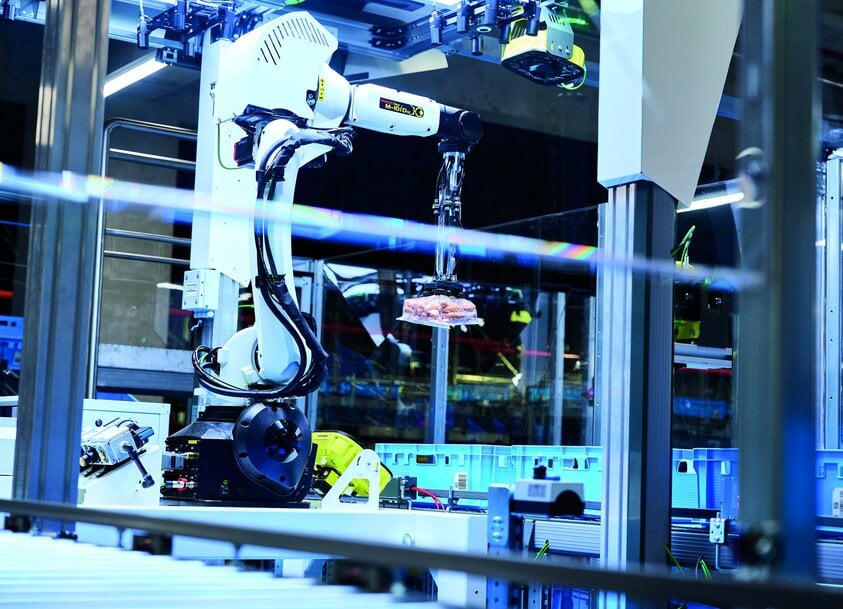
EDEKA has expanded the intralogistics system at its NORDfrische distribution center in Lüttow-Valluhn, Germany, with the integration of two AI-powered Pick-it-Easy Robots from KNAPP. Operating continuously in a strict +2°C environment, the robotic cells fully automate the picking of individual fresh meat, sausage, and deli items. By relieving employees from physically strenuous tasks in refrigerated conditions, the retailer aims to bolster supply chain resilience and scale fulfillment capacity for the 650 stores served by the facility.
AI-powered robotic picking in cold chain logistics
Processing up to 450 picks per hour, each robotic cell utilizes intelligent image-processing systems to reliably identify and handle a wide variety of product shapes and packaging types. Beyond simple material handling, the robots perform concurrent process steps, such as scanning barcodes and recording the weight of each individual item. The integration builds upon an 86,000-square-foot automated footprint that processes up to 40,000 containers daily. Meat products are stored in a high-density shuttle system featuring 70,000 locations before being routed to various picking zones based on turnover rates.
Orchestrating multi-modal fulfillment with KiSoft
To accommodate diverse order structures, EDEKA balances operations across ergonomic Pick-it-Easy goods-to-person workstations, Pick-to-Light stations, and the new fully automated robot cells. The entire material flow—from goods-in and automated palletizing to route-optimized shipping in insulated containers—is governed by KNAPP’s KiSoft software suite. The software provides real-time visibility into inventory and capacity, dynamically optimizing storage strategies and deploying resources to maintain a seamless, unbroken cold chain from the processing facility to the retail shelf.
Additional Context: The challenges of robotic picking in fresh grocery
This section details technical specifications and competitive benchmarking not included in the original project announcement.
Automating piece-picking in fresh grocery intralogistics presents severe thermodynamic and mechanical challenges compared to standard e-commerce fulfillment. The primary obstacle is the extreme physical variability of the products: unlike rigid, standardized cardboard boxes, fresh meats in vacuum packs or modified atmosphere packaging (MAP) shift in weight, shape, and center of gravity. Furthermore, traditional robotic suction grippers struggle to establish a secure vacuum on cold, potentially condensation-covered plastic films. To overcome this, advanced picking robots rely on AI-driven computer vision and machine learning networks trained specifically on diverse, non-rigid grocery items. The vision system must calculate the optimal grasping point dynamically, while the robotic arm utilizes specialized end-effectors capable of handling delicate, moist, and irregularly shaped items without damaging the packaging—all while operating continuously in a refrigerated, high-humidity environment that demands specialized condensation mitigation for optical sensors and kinematics.
Edited by an industrial journalist, Lekshman Ramdas, with AI assistance.
www.knapp.com
