
www.foodpackautomation.com
06
'26
Written on Modified on
Bürkert Type 8880 optimizes pressure control in hygienic manufacturing
The integrated system delivers sub-200 millisecond response times to prevent pressure drift in pharmaceutical and beverage applications.
www.buerkert.de
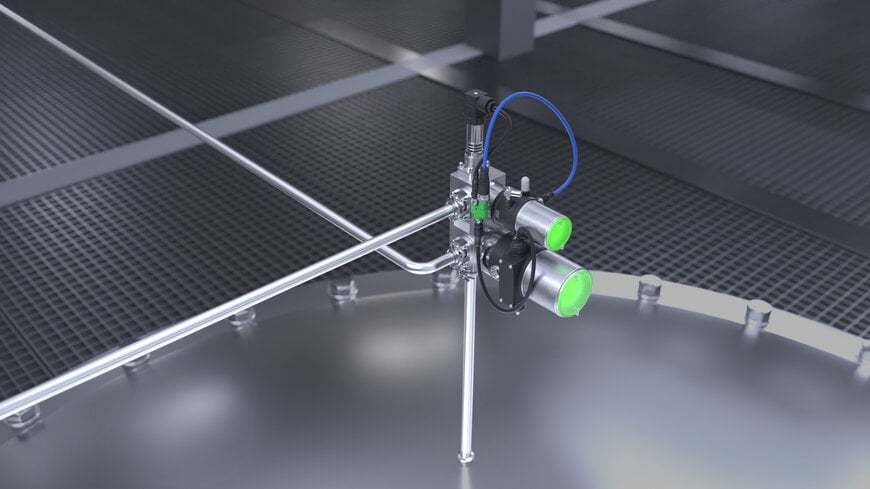
In hygienic manufacturing environments—ranging from biologic drugs and vaccines to carbonated beverages—maintaining highly stable gas pressure within process and storage vessels is critical for ensuring product consistency and maximizing yield. To address the detrimental effects of pressure drift during dynamic production phases, Bürkert has introduced the Type 8880 pressure control system. Developed specifically for stringent sanitary applications, the technology drastically reduces control loop latency, enabling manufacturers to maintain precise overpressure and optimize continuous processing.
Eliminating control loop latency for precision filling
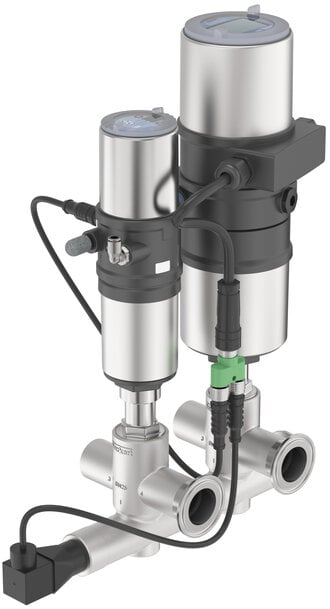
Conventional pressure control architectures typically rely on a fragmented arrangement of separate sensors, shut-off valves, and external controllers. The communication delays inherent in these decentralized setups can result in response times of several seconds, allowing transient pressure drift that directly impacts dosing accuracy and fermentation stability. Bürkert solves this bottleneck by consolidating two control valves and a pressure transmitter into a single, closed-loop integrated design. This architecture achieves response times of less than 200 milliseconds—up to ten times faster than standard solutions.
This rapid modulation proved essential for WEIGHTPACK, an Italian filling equipment specialist. The company utilizes overpressure within its filler tanks to accelerate product flow and minimize fill times. By adopting the Type 8880 system, WEIGHTPACK replaced a complex, sluggish valve arrangement with a highly responsive controller, ensuring that tank pressure remains completely stable even during highly dynamic start-up and shutdown phases, ultimately guaranteeing accurate net-weight filling.
Robust sanitary design for CIP and SIP cycles
Beyond real-time control performance, hygienic processing equipment must withstand the aggressive thermal and chemical stresses of routine Clean-In-Place (CIP) and Steam-In-Place (SIP) protocols. The Type 8880 is engineered to endure these rigorous cleaning cycles without the lubrication degradation that often causes conventional valves to fail. To meet strict regulatory standards, the system is highly configurable, featuring self-draining geometries, electropolished surfaces, FDA-compliant construction materials, and specialized dead-space reduced variants that prevent biological contamination.
Additional Context: Fluid dynamics of overpressure and dead-space microbiology
This section details the physical principles of high-speed filling and hygienic piping not included in the original press release.
In high-speed liquid filling operations, the volumetric flow rate through a dispensing nozzle is fundamentally dictated by the differential pressure across it (in accordance with Bernoulli's principle). By applying a precise, constant artificial overpressure (head gas) inside the filler bowl, manufacturers can force viscous fluids into containers much faster than gravity alone would allow, dramatically increasing throughput. However, if this headspace pressure fluctuates even slightly due to control loop latency, the flow rate instantaneously destabilizes, causing unacceptable variations in dosing weights and triggering product rejection.
Furthermore, in pharmaceutical bioprocessing, the physical geometry of control valves is just as critical as their electronic speed. Conventional piping and valves often contain "dead legs"—stagnant recesses or blind branches where fluid velocity drops to near zero. These dead zones represent a severe contamination risk because the turbulent flow of alkaline cleaning chemicals (like sodium hydroxide) or high-temperature sterilization steam cannot fully penetrate them during CIP/SIP cycles. This allows surviving microorganisms to adhere to the steel and secrete a protective extracellular matrix, forming highly resistant biofilms. Dead-space-free valve designs and electropolishing (which reduces surface roughness at a microscopic level) physically eliminate these refuges, ensuring total system sterility and FDA compliance.
Edited by an industrial journalist, Lekshman Ramdas, with AI assistance.
www.burkert.com
