
www.foodpackautomation.com
10
'26
Written on Modified on
MASDAC simplifies food machinery wiring with Rockwell Automation technology
The On-Machine solution reduces cabling, improves fault detection and maintenance, and supports flexible production line expansion and future automation.
www.rockwellautomation.com
Application Area: Industrial Automation and Control Systems
Industry Sector: Food Processing and Packaging Machinery
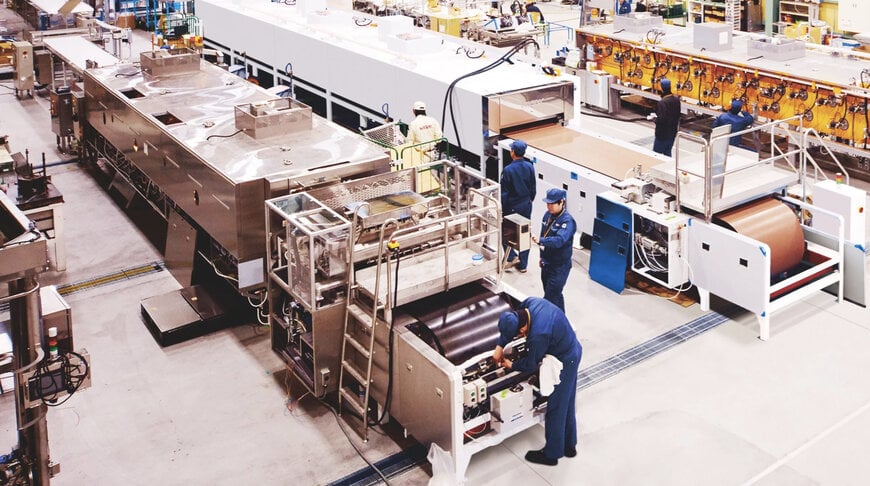
MASDAC Co., Ltd., a Japan-based manufacturer of confectionery processing machinery and baked goods founded in 1957, updated the control architecture of its automated baking equipment built for export to North America. To meet strict regional safety regulations and align with end-user hardware preferences in overseas processing facilities, the engineering team transitioned from centralized cabinet configurations to a decentralized on-machine drive and safety layout.
Operational Challenges in Centralized Control Cabinets
Industrial food production lines require high electrical reliability, labor-saving operation, and compliance with stringent regional standards such as UL certification. MASDAC previously routed individual long-distance power and feedback cables from a centralized enclosure to every servo motor across the frame. This layout increased engineering drawing complexity, extended panel assembly labor, and complicated wiring management on the factory floor.
At the same time, North American end users required streamlined spare parts inventories and standardized hardware compatible with existing plant maintenance protocols. To satisfy these operational requirements, MASDAC had to decrease wiring volume, simplify fault diagnosis, and ensure the mechanical platform could be scaled for subsequent plant retrofits.
Decentralized Drive and Safety Integration
MASDAC selected a distributed control topology from Rockwell Automation, mounting IP-rated motion hardware and safety nodes directly onto the machine frame adjacent to the actuators. The configuration utilizes distributed servo drives alongside a linked safety device protocol connecting emergency stops and interlock switches.
Decentralizing the servo architecture moved drive electronics out of the central enclosure and adjacent to the motors, transitioning point-to-point connections to an in-line power and communication trunk. In parallel, the safety network connected interlocking devices along a single cable run while preserving individual diagnostic visibility for each node.
Measurable Cabling Reductions and Diagnostic Improvement
The transition delivered measurable decreases in electrical installation workloads and maintenance demands:
- Cable Reduction: The connection from the main control cabinet to the servo group dropped from seven dedicated long-run cable assemblies down to a single distribution line.
- Enclosure Utilization: Relocating drive hardware directly to the machine structure substantially reduced internal cabinet footprint, leaving space for future field upgrades.
- Fault Diagnosis: Diagnostic indicators on networked safety devices pinpoint tripped interlocks or wiring faults immediately, eliminating point-to-point continuity tracing during downtime events.
"Previously, we had to route seven long servo cables. With the new system, only a single long cable is required from the control panel. The number of devices installed inside the panel has also been reduced, creating much more space within the enclosure. Maintenance and future equipment additions have become easier, and the modular design makes it simpler to modify production lines or expand equipment in the future," stated Nobukatsu Kurosaki, Corporate Officer and General Manager of the Production Division at MASDAC Co., Ltd.
The decentralized architecture establishes a modular design standard for future machine revisions, simplifying assembly, streamlining regional safety compliance, and accelerating fault remediation for manufacturing clients.
Edited by Natania Lyngdoh, Induportals editor, with AI assistance.
www.rockwellautomation.com
