

www.foodpackautomation.com
10
'26
Written on
Modified on
Easyfairs News
Packaging economics shift as regulation drives circular design
Smithers and Easyfairs examine how packaging regulation, recycled content and circularity are changing material and design decisions.
www.easyfairs.com
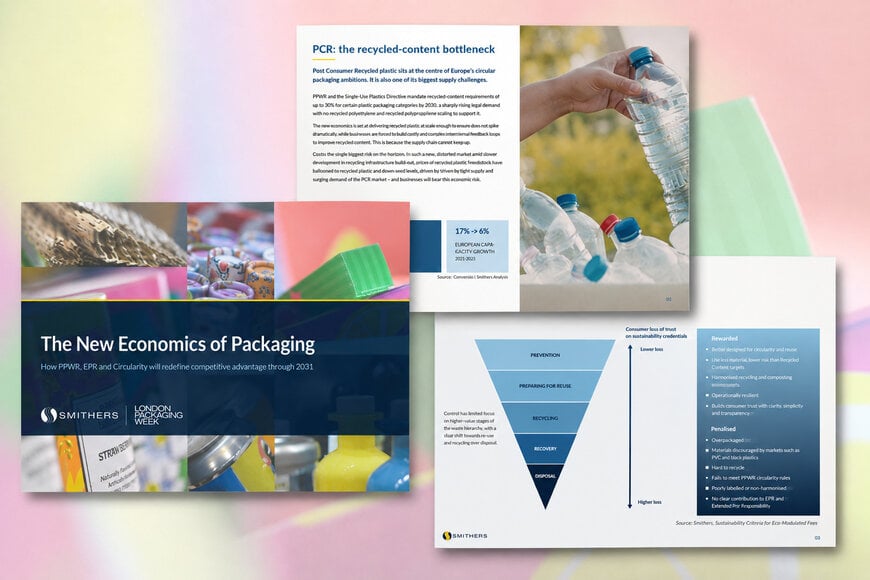
Smithers and Easyfairs, through their cooperation around London Packaging Week 2026, are examining how European packaging regulation is changing the economic factors behind material selection, recyclability and packaging design. Their work focuses on the impact of the Packaging and Packaging Waste Regulation (PPWR), Extended Producer Responsibility (EPR) and circularity requirements on packaging producers and users across FMCG, beauty, luxury and premium drinks.
Regulation links packaging design to cost
The cooperation combines Smithers’ packaging market intelligence with London Packaging Week’s industry platform to examine how regulatory requirements translate into operational and financial decisions. The report, The New Economics of Packaging: How PPWR, EPR and Circularity Will Redefine Competitive Advantage Through 2031, identifies packaging design as an increasingly important factor in producer costs and supply-chain planning.
The PPWR begins to apply from 12 August 2026 and introduces requirements covering recyclability, recycled content, packaging efficiency, reuse and labelling. These requirements affect the materials and formats that companies can place on the European market.
EPR schemes are also changing cost structures through eco-modulated fees. Lightweight, recyclable and mono-material packaging compatible with existing recycling systems can qualify for lower producer fees, while formats that are more difficult to recover can incur higher costs.
Recycled content creates supply-chain constraints
A key issue examined by Smithers and Easyfairs is the availability of recycled plastic. PPWR requirements reach up to 30% recycled content for certain plastic packaging categories by 2030, while the supply of suitable post-consumer recycled material remains constrained.
According to the report, PCR plastic already costs approximately one-third more than virgin polymer. European recycling-capacity growth also slowed from 17% to 6% between 2021 and 2023. These conditions make long-term access to recycled feedstock an important consideration in packaging procurement and design.
Material choices also face carbon-related requirements. For metal packaging, the Carbon Border Adjustment Mechanism introduces additional considerations for steel and aluminium supply chains, linking material sourcing decisions with embedded carbon and regulatory exposure.
Packaging efficiency and infrastructure
The cooperation also addresses packaging efficiency. PPWR introduces a 50% maximum empty-space ratio for transport and e-commerce packaging and establishes requirements related to reuse and harmonised labelling. These measures increase the importance of packaging optimisation alongside material recovery and recyclability.
Smithers will present its research at London Packaging Week 2026 on 16–17 September at ExCeL London. The event will provide a setting for packaging professionals to discuss the technical and commercial implications of regulatory changes with market intelligence specialists and industry participants.
Edited by Sucithra Mani, Induportals editor – adapted by AI.
www.easyfairs.com
