
www.foodpackautomation.com
23
'26
Written on Modified on
How Are Water-Based Coatings Replacing Plastic Seals?
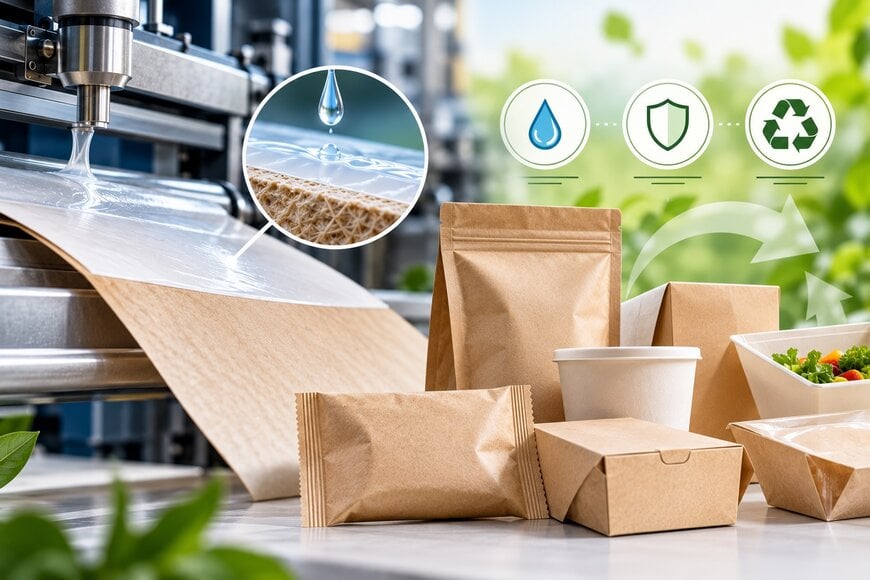
Henkel, BASF, Dow and Michelman are developing water-based heat-seal coatings that help paper food packaging replace conventional polyethylene sealing layers while retaining package integrity and supporting fibre recovery.
induportals-media-publishing.com
Introduction
Replacing plastic packaging with paper requires more than a recyclable substrate. Food packages must withstand handling, protect against moisture or grease, and form reliable seals on industrial packaging lines. Water-based heat-seal coatings address this challenge by depositing functional polymer layers onto paper and paperboard, potentially eliminating the need for conventional polyethylene (PE) coatings in suitable applications.
Current Technology Market Landscape
These coatings combine sealing and barrier functions, but their formulations differ according to the packaging application. Paper cups require resistance to hot liquids, while food pouches need reliable seals and protection against moisture or grease. Performance depends on coating chemistry, coat weight, drying conditions, substrate properties and the temperature, pressure and dwell time used during sealing.
The engineering objective is to achieve sufficient seal strength without compromising production speed, food-contact requirements or the recyclability of the finished package.
Core Market Challenge
Conventional PE coatings provide effective sealing and liquid resistance but can complicate fibre recovery during paper recycling. Water-based alternatives must deliver comparable functionality while adhering to paper surfaces, resisting cracking at folds and maintaining seal integrity under different storage and handling conditions.
Another challenge is heat management. Lower seal-initiation temperatures can reduce the energy required to form a seal and potentially support faster packaging-line operation. However, performance must be validated for each combination of coating, paper substrate and machine settings.
Existing Technology Solutions
Henkel's LOCTITE LIOFOL HS 2819 RE is a heat-seal coating designed to replace PE-coated paper in suitable packaging structures. It can be applied using flexographic or rotogravure processes and is designed to seal against itself or paper. Henkel also reports recycling compatibility based on testing by accredited institutes, with food-contact suitability subject to applicable conditions.
BASF's Joncryl HPB 4012 is a styrene-acrylic dispersion designed as an alternative to extruded polyethylene or wax coatings. Its technical documentation identifies water resistance, heat-sealability and suitability for cups, boxes and other food-paper packaging. It can be applied using rod, blade or curtain coating, as well as flexographic and gravure converting processes.
Dow's RHOBARR 320 is a water-based barrier dispersion intended for paper, board and moulded-fibre applications. Its published specifications include 43% solids by weight, a pH of 9 and viscosity below 1,500 cP under the stated Brookfield test conditions. It provides hot- and cold-liquid barriers alongside oil and grease resistance and heat-sealability. Dow identifies cupstock and food-service packaging as target applications.
Michelman's water-based heat-seal coatings target flexible and rigid packaging structures. The company reports seal-initiation temperatures starting at 65°C and bond strength of up to 800 g/25 mm, depending on the paper. These properties can help reduce sealing-energy requirements while supporting adhesion across different substrates.
Actual Implementation on the Ground
The coatings are designed for integration into established paper-coating and converting operations. Depending on the formulation and packaging design, potential applications include cups, cartons, food-service containers and paper-based flexible packaging.
However, recyclability cannot be established from the coating alone. The complete package—including inks, other barrier layers, adhesives and coating weight—must be assessed under relevant recycling tests. Similarly, sealing performance depends on the specific production line and package design.
Summary and Strategic Future Outlook
Water-based heat-seal coatings are creating alternatives to conventional PE layers in selected paper food-packaging applications. Competition centres on seal strength, barrier performance, processing flexibility and demonstrated fibre recovery. Further adoption will depend on validating these properties across specific food products and commercial packaging lines.
Edited by Lekshman Ramdas, Induportals editor – adapted by AI.
www.foodpackautomation.com
