
www.foodpackautomation.com
26
'26
Written on Modified on
Can AI Sorters Spot What Human Eyes Miss?
Deep learning and hyperspectral sensors redefine foreign-object detection, allergen separation, and yield optimization across modern food processing lines.
induportals-media-publishing.com
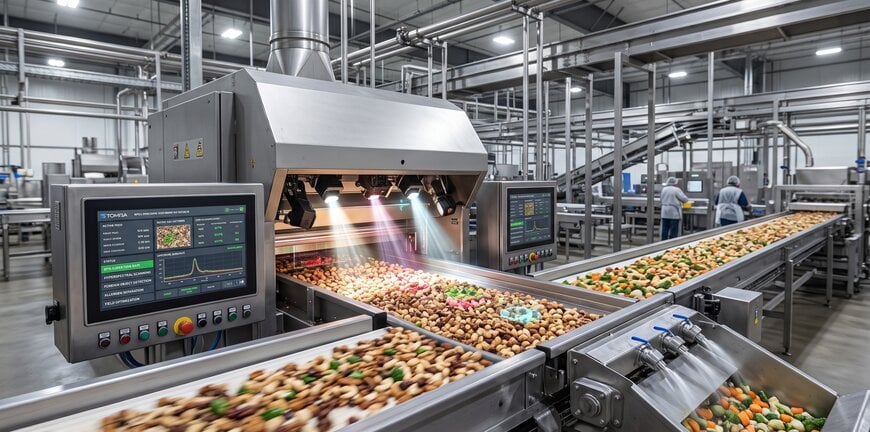
Modern food sorting has moved beyond conventional color-and-shape thresholds into multi-sensor systems driven by convolutional neural networks (CNNs) and spectral imaging. Rather than relying solely on RGB cameras to spot obvious discoloration, AI-powered optical sorters combine visible-spectrum cameras, near-infrared (NIR) and short-wave infrared (SWIR) sensors, lasers, and hyperspectral imaging to evaluate both surface morphology and internal chemical composition in real time. This architecture enables processors to separate visually identical defects, low-density foreign materials, and allergenic cross-contaminants at industrial belt speeds.
Current Technology Market Landscape
The global AI-based food quality inspection system market is estimated at USD 1.72 billion in 2026, with machine vision powered by deep learning accounting for 41.5% of technology revenue and sorting and grading representing 36% of application demand. Hardware—including high-speed cameras, spectral sensors, and pneumatic or mechanical ejection manifolds—still represents 54% of market value, though software licenses and model-retraining services are expanding as standard line items. Concurrently, the broader hyperspectral imaging systems market reached an estimated USD 401.73 million in 2026, propelled by miniaturized snapshot cameras and visible-to-near-infrared (VNIR) sensors transitioning from laboratory benches to inline food processing.
Core Market Challenge
Deploying AI sorting on high-volume food lines involves more than upgrading camera resolution. Raw agricultural feedstocks fluctuate continuously in moisture content, color tone, and defect profiles across harvests and growing regions, which causes rigid rule-based sorters to drift and generate excessive false rejects. Processors must also detect non-metallic, low-density contaminants—such as plastics, wood, insects, and visually identical grains—that evade traditional metal detectors and single-spectrum cameras. Meanwhile, real-time deep-learning inference must execute within milliseconds at conveyor speeds of several meters per second, all while maintaining hygienic, washdown-ready enclosures and minimizing good-product loss.
Existing Technology Solutions
TOMRA Food deploys its LUCAi deep-learning platform across more than 3,500 grading lanes worldwide for apples, blueberries, cherries, and citrus. In September 2025, the company launched the TOMRA 4C AI-powered sorter for nuts and individually quick-frozen (IQF) vegetables, achieving greater than 97% detection on defects and foreign materials with a false-reject rate of less than 1%. It complements the TOMRA 4A bulk potato sorter, which combines pulsed LED+ and infrared optics with LUCAi to process up to 100 tons per hour with a single operator.
Bühler Group introduced the SORTEX AI700 in May 2025 as its first CNN-based deep-learning optical sorter. Analyzing grains at the pixel level, its initial commercial application targets the separation of visually similar gluten-containing grains—barley, wheat, and rye—from certified gluten-free oats, achieving a 5–10% improvement in reject concentration to preserve usable yield.
Key Technology, a Duravant company, offers the VERYX 2.0 digital sorting platform and the COMPASS belt-fed optical sorter, which received new performance enhancements in October 2026. Pairing multi-sensor inspection with AI-driven Sort-to-Grade software and Industry 4.0 data analytics, these systems automate foreign-material removal and defect grading across fresh and IQF vegetables, potatoes, and nuts.
Actual Implementation on the Ground
TOMRA's LUCAi deployments demonstrate that pre-trained deep-learning models can be retrofitted onto existing sorting lanes to cut false rejects within a single season, while the TOMRA 4A operates at intake to remove rot, dirt, and stones before cold storage. Bühler's SORTEX AI700 addresses a specific regulatory and safety bottleneck by separating visually similar gluten-containing grains from certified gluten-free oats. Key Technology's October 2026 COMPASS enhancements—adding backlight technology and three-way sorting—enable vegetable and potato processors to grade multiple product classes on a single belt-fed line.
Summary and Strategic Future Outlook
Optical and spectral sorting is shifting from static defect rejection to adaptive yield management. As spectral sensors become more compact and affordable, and as pre-trained deep-learning models reduce the burden of seasonal recalibration, mid-sized food processors will adopt technologies once limited to Tier-1 facilities. Future competitiveness will hinge on how seamlessly sorting hardware integrates with plant-wide data systems—linking real-time rejection trends directly to upstream equipment maintenance and automated food-safety traceability.
Edited by Lekshman Ramdas, Induportals editor – adapted by AI.
www.foodpackautomation.com
