
www.foodpackautomation.com
09
'26
Written on Modified on
Automated Vacuum Packaging Line Integration
ULMA Packaging combines FLOW-VAC technology and Line Controller with SUPERVAC equipment to automate bag forming and eliminate packaging line bottlenecks.
www.ulmapackaging.com
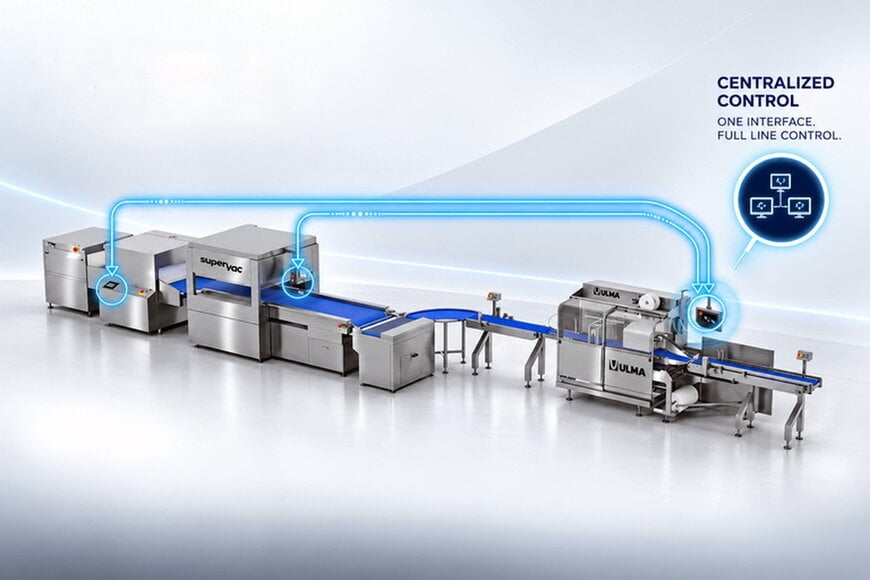
Industrial food processors face persistent throughput bottlenecks and high labor overhead when manually sizing, bagging, and vacuum-sealing variable-dimension fresh food products. ULMA Packaging addresses these processing inefficiencies by coupling its FV 35 FLOW-VAC machine and Line Controller architecture with SUPERVAC vacuum chamber equipment, delivering an automated packaging solution designed for primary food packaging environments.
Engineering Challenge and Automated Bag-Forming Mechanics
Standard vacuum packaging operations handling variable-length items such as primal meat cuts, cheese blocks, or poultry traditionally depend on pre-made shrink bags. This approach introduces two critical points of operational loss: frequent manual intervention by operators who must select and handle specific bag SKUs, and sealing contamination that occurs when product moisture contacts the bag opening during manual loading.
The FV 35 system automates this handling stage by forming a customized shrink bag directly around each individual product item from a single roll of barrier film. Because the continuous film feed matches the exact length of each passing item, the mechanism minimizes overall film consumption and eliminates inventory management for multiple pre-cut bag sizes. Concurrently, the bottom-feed bag-forming sequence protects the longitudinal and transverse sealing zones from product fluid contact, preventing micro-channel seal defects and reducing finished-pack vacuum leakage rates before items reach the evacuation stage.
Centralized Line Architecture and Operational Control
After automated bag formation and loading, packages transition into the integrated SUPERVAC chamber equipment for air evacuation and final sealing. Operating complex, multi-vendor packaging lines often degrades Overall Equipment Effectiveness (OEE) due to disparate controls and decentralized changeover steps.
To resolve this integration barrier, the system routes line management through the ULMA Line Controller via a single human-machine interface (HMI). Operators manage production runs using centralized recipe records linked directly to facility SKU identifiers. Selecting a product SKU automatically distributes target operational parameters to sub-recipes across both ULMA bag-forming units and SUPERVAC vacuum chambers simultaneously, reducing downtime during changeovers.
Remote diagnostic visibility across the line is supported through Virtual Network Computing (VNC) protocols integrated into the controller interface. Operators can interact with individual machine screens from the primary terminal, verifying operational status, clearing localized alarms, and evaluating transfer-point status across the complete packaging cell.
Data Acquisition, Diagnostics, and OEE Optimization
Process analytics within the line controller are organized through the OEE Booster utility. The software logs machine state changes, stop codes, line cycle rates, and rejection counts directly from connected machine controllers to isolate systemic performance losses.
By segregating macro-level line availability data from localized machine stoppage causes, maintenance engineers can determine whether throughput drops stem from upstream bag-forming stoppages, inter-machine transfer timing errors, or chamber pump cycles. Traceability logs and line diagnostic metrics compile into automated PDF performance summaries to support root-cause analysis and preventive maintenance scheduling.
Additional Context
This section details technical specifications and competitive benchmarking not included in the original product announcement.
In industrial vacuum packaging for fresh proteins, processors typically choose between three main architectures: manual loading into pre-fabricated shrink barrier bags, thermoforming deep-draw vacuum packaging, or automated flow-wrapping with downstream vacuum chambers.
Traditional pre-formed bagging lines incur high packaging material expenses per unit and remain sensitive to operator handling speed, often topping out at 15 to 30 packs per minute depending on staffing levels. Thermoforming machines provide high-speed automated output but exhibit limited flexibility when cycling through products with wide variations in length and profile, requiring costly tooling changeouts.
FLOW-VAC configurations function as an intermediate engineering solution. By utilizing continuous roll stock to form tubular shrink barrier film dynamically around irregular products, processors lower raw film costs relative to pre-made bags while maintaining cycle flexibility across varying product profiles without hardware changeovers. Industry benchmark integrations for automated flow-vacuum systems typically interface with high-capacity continuous belt vacuum chambers, where synchronized infeed belts transfer loaded packs directly into evacuation chambers operating at vacuum depths below 5 mbar. Integrating machine communication via industrial Ethernet protocols and remote management architectures aligns these packaging cells with PackML (Packaging Machine Language) operational standards and ISA-88 batch control frameworks, optimizing line availability in high-volume food processing plants.
Edited by Evgeny Churilov, Induportals Media - Adapted by AI.
www.ulmapackaging.com
