
www.foodpackautomation.com
15
'25
Written on Modified on
Agentic Digital Twins in Beverage Manufacturing
Krones integrates AI-driven digital twins with its technology partners to accelerate simulation, optimization, and decision-making in beverage production systems.
www.krones.com
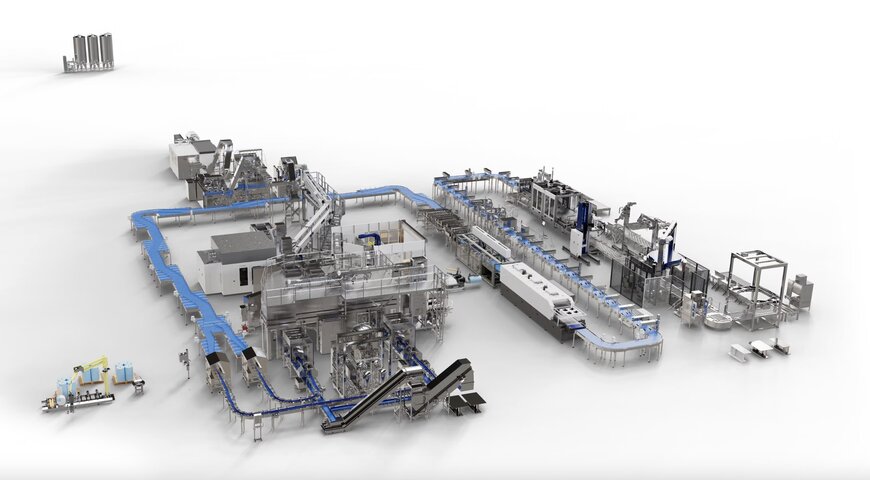
Krones has implemented a new generation of digital twins that combine physically accurate simulations with AI-based reasoning to optimize filling and packaging operations in beverage manufacturing.
From static models to agent-based digital twins
Traditional digital twins in industrial environments have primarily served as virtual replicas used for offline analysis and operator-guided optimization. Krones’ latest implementation extends this concept by embedding AI agents into digital twins of filling and packaging machines, enabling autonomous reasoning, decision-making, and iterative optimization.
Developed with a technology ecosystem including Ansys (part of Synopsys), CADFEM, Microsoft, NVIDIA, and SoftServe, the system integrates real-time physics-based simulation with artificial intelligence capable of testing, evaluating, and refining operational parameters without manual intervention.
Reducing simulation time for operational relevance
A key technical limitation of earlier simulation approaches was execution speed. At Krones, individual simulation runs previously required three to four hours, restricting their use to offline planning and limiting responsiveness in dynamic production environments.
By combining high-precision computational fluid dynamics models with NVIDIA Omniverse libraries, OpenUSD, and Ansys Fluent running in a cloud environment, Krones reduced simulation cycles to under five minutes. This performance improvement allows multiple scenarios to be evaluated in near real time, supporting operational decision-making rather than post-process analysis.
The simulations are executed on Microsoft Azure using NVIDIA-accelerated computing, providing scalable processing capacity for computationally intensive fluid dynamics and machine behavior models.
AI-driven optimization loops
Within the digital twin application, AI agents operate in an iterative optimization loop. They adjust variables such as filling speed, temperature, pressure, and control logic, execute simulations, analyze outcomes, and refine parameters autonomously. Over successive iterations, the system learns which configurations deliver optimal results for defined performance criteria.
Validated configurations are transferred directly from the digital environment to physical machines, enabling immediate comparison between simulated and real-world performance and supporting faster implementation of process improvements.
Relevance for fluid-intensive production processes
Beverage production places specific demands on automation systems due to the complex behavior of fluids during filling and packaging. Parameters such as flow dynamics, turbulence, and pressure fluctuations must be tightly controlled to prevent waste, defects, or downstream disruptions.
By digitally mirroring these physical processes with high fidelity, agentic digital twins allow continuous monitoring and optimization of fluid behavior at machine and line level. This capability supports more stable operations, improved resource efficiency, and reduced material losses.
Industrial implications beyond beverage manufacturing
The introduction of autonomous, self-optimizing digital twins represents a broader shift in industrial automation. Unlike earlier systems that relied on human interpretation, agent-based digital twins can respond directly to real-time data and trigger adjustments automatically.
For Krones, this approach establishes a foundation for future extensions of its digital twin strategy across machines, lines, and entire plants. More broadly, it demonstrates how industrial AI and cloud-based simulation can converge to enable self-optimizing automation systems with measurable gains in speed, efficiency, and operational agility.
www.krones.com
