
www.foodpackautomation.com
16
'25
Written on Modified on
In-Mold Coatings in Rigid Packaging Production
ACTEGA develops specialized coating systems for in-mold labelling used in food and industrial containers, supporting efficient molding, stable printing, and mono-material packaging designs.
www.actega.com
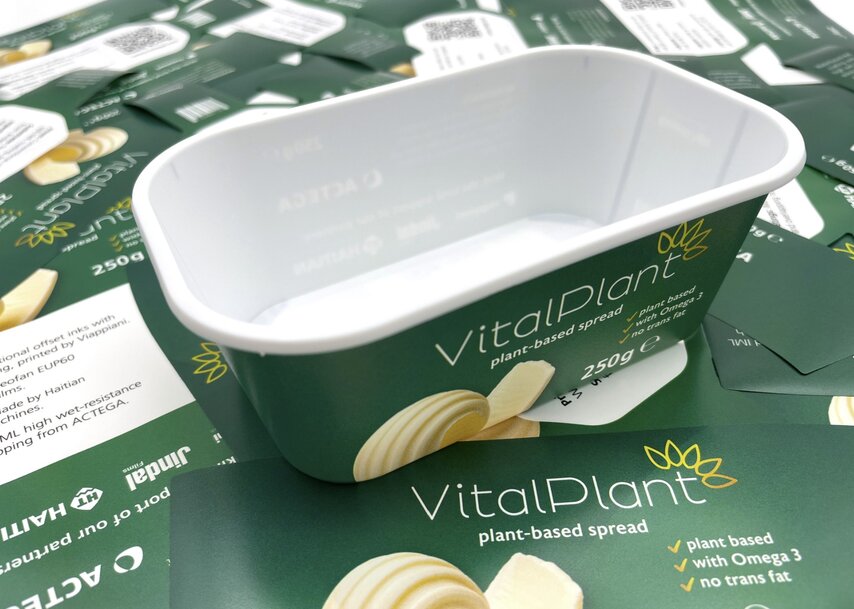
In-mold labelling (IML) integrates decoration directly into the injection-molding of rigid plastic containers, reducing downstream steps while delivering durable, high-quality graphics. ACTEGA, a manufacturer of coatings and functional materials for print and packaging, supplies IML-specific coating systems designed to support this combined forming-and-decoration process across food and industrial applications.
Where in-mold labelling fits in modern packaging lines
IML is commonly applied to injection-molded products such as yogurt cups, margarine tubs, and paint buckets. A pre-printed polymer label is placed inside the mold—typically held by controlled static electricity—before molten polypropylene is injected. During molding, the label fuses permanently with the container wall, completing decoration and forming in a single cycle.
For converters, this approach removes secondary labelling operations, reduces handling, and supports high-volume, repeatable production. Because both the label and container are typically polypropylene, IML also enables mono-material packaging structures that are easier to recycle than multi-material alternatives. These characteristics have made IML particularly relevant in food packaging and industrial applications where durability, wash resistance, and regulatory compliance are required.
Why coatings determine process reliability
Although coatings represent a thin functional layer, they play a central role in IML performance. During printing, die-cutting, molding, and end use, the coating must protect printed inks from abrasion, heat, and moisture while maintaining dimensional and surface stability.
A key technical function is static control. The coating must suppress unwanted static during printing and converting, while still allowing sufficient electrostatic charge for accurate label positioning inside the mold. Poor static management can lead to misplacement, rejected parts, or unstable cycle times. Coating formulation also influences mold cleanliness; systems designed to limit residue build-up reduce cleaning frequency and unplanned downtime.
Matching coating chemistry to printing and molding conditions
IML coatings are produced in water-based, UV-curable, and solvent-based systems, each selected according to printing technology, regional regulations, and application constraints. Water-based coatings are widely used in Europe due to their compatibility with offset printing, lower migration risk, and suitability for food-contact packaging. UV-curable coatings, known for high surface clarity and gloss, are more prevalent in parts of Asia, though their use in food packaging is more selective due to migration and safety requirements.
Across printing methods—including flexographic, gravure, offset, digital, letterpress, and screen printing—the coating must be adapted to ink chemistry, label film, and surface finish requirements such as matte, gloss, or textured effects. Process consistency depends on precise formulation handling, including uniform mixing for additive distribution, correct anilox roller selection, and controlled drying conditions. These parameters directly affect coating transfer, durability, and molding behavior.
Market adoption and regional dynamics
IML accounts for roughly 2% of the global label market, but adoption continues to expand. Europe represents more than 50% of current usage, supported by established injection-molding infrastructure and food packaging demand. North America, historically dominated by blow-molded containers, has seen injection-molded IML grow by more than 20% as local capabilities expand. In Asia, particularly India, new consumer brands are increasingly adopting IML, while emerging markets in Africa and South America show rising interest as manufacturing capacity develops.
ACTEGA supplies IML coatings globally, with products used across more than 50 countries and adapted to regional climate conditions, production standards, and regulatory frameworks.
Sustainability considerations in mono-material packaging
From a lifecycle perspective, IML supports recyclability by eliminating adhesives and secondary labels made from dissimilar materials. When both container and label are polypropylene, the package can enter standard recycling streams without separation. Ongoing development in coating formulations focuses on maintaining surface performance while supporting recyclability and reducing process-related waste.
By addressing functional requirements at the coating level—static control, heat resistance, print protection, and mold cleanliness—ACTEGA positions in-mold coatings as a technical enabler of stable, efficient IML production. In practice, coating selection directly influences line reliability, output quality, and the ability to meet regulatory and sustainability targets in modern rigid packaging operations.
www.actega.com
