
www.foodpackautomation.com
08
'26
Written on Modified on
Integrated Automation for Industrial Food Processing
JBT Marel presents connected processing systems at CFIA 2026 to demonstrate how integrated equipment, software, and services support efficiency, yield control, and operational resilience in food production.
marel.com
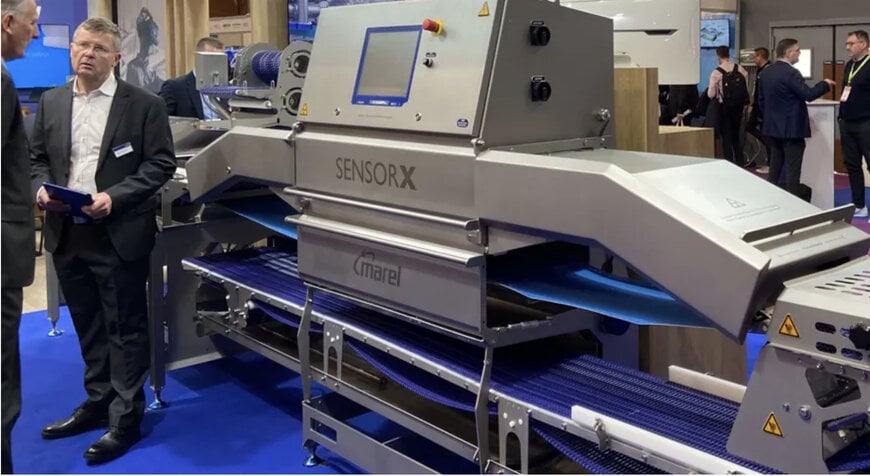
At CFIA 2026 in Rennes, France, JBT Marel will present end-to-end food processing systems that integrate automation, software, and lifecycle services for poultry, meat, fish, and prepared food applications.
Processing Integration as a Technical Focus
The presentation by JBT Marel at CFIA 2026 emphasizes system-level integration rather than individual machines. The approach combines connected equipment, control software, and service models designed to reduce material loss, stabilize throughput, and improve consistency across full production lines. The target industries include poultry, red meat, seafood, prepared foods, and diversified food and health products, where raw material variability and labor availability directly affect yield and cost.
CFIA 2026 took place from 10–12 March 2026 at Parc Expo Rennes, bringing together equipment suppliers and processors focused on industrial-scale food manufacturing.
From Intake to Packaging: System-Level Design
JBT Marel’s technical narrative centers on line architectures that link intake, primary processing, further processing, and packaging into a single operational framework. By synchronizing machine controls and production data across these stages, processors can better balance line speed, reduce bottlenecks, and improve utilization of raw materials. Such integration is particularly relevant for high-volume operations where small efficiency gains translate into measurable reductions in waste and rework.
Automation is positioned as a mechanism for consistency rather than labor replacement alone. Standardized process control supports uniform product quality, while predictive maintenance functions are intended to improve uptime by identifying service needs before failures occur.
Automation, Data, and Service Continuity
A key technical element highlighted is the role of proactive service models linked to equipment performance data. Installation, maintenance, and ongoing optimization are treated as part of a continuous operational loop. This approach aligns with broader trends toward a digital supply chain in food processing, where equipment status, process parameters, and production outcomes are monitored and adjusted in near real time.
Immersive Visualization of Processing Lines
In Hall 8, booth A3, JBT Marel presented an immersive, custom-built visualization environment designed to replicate complete processing plants virtually. Using large-format 3D displays, videos, and interactive walkthroughs, the space allows visitors to examine end-to-end production flows without physical access to a factory floor. For poultry processing, virtual scenarios covered systems such as VC-i, Nuova-i, ATHENA, FHF FlexControl, ALPINE, WingMaster, and ProFlow, illustrating how individual modules interact within a unified line.
A separate immersive scenario focused on prepared foods, showing a full further-processing sequence from meat mass preparation and forming through coating, freezing, batching, and tray sealing. The intent is to provide technical context for how integrated lines behave under production conditions, including material flow and process transitions.
Relevance for Industrial Food Producers
The CFIA 2026 presentation positions integrated automation and visualization as tools for decision-making in plant design and optimization. By examining complete systems rather than isolated machines, processors can better evaluate how changes in one stage affect yield, quality, and efficiency across the entire operation.
Processing Integration as a Technical Focus
The presentation by JBT Marel at CFIA 2026 emphasizes system-level integration rather than individual machines. The approach combines connected equipment, control software, and service models designed to reduce material loss, stabilize throughput, and improve consistency across full production lines. The target industries include poultry, red meat, seafood, prepared foods, and diversified food and health products, where raw material variability and labor availability directly affect yield and cost.
CFIA 2026 took place from 10–12 March 2026 at Parc Expo Rennes, bringing together equipment suppliers and processors focused on industrial-scale food manufacturing.
From Intake to Packaging: System-Level Design
JBT Marel’s technical narrative centers on line architectures that link intake, primary processing, further processing, and packaging into a single operational framework. By synchronizing machine controls and production data across these stages, processors can better balance line speed, reduce bottlenecks, and improve utilization of raw materials. Such integration is particularly relevant for high-volume operations where small efficiency gains translate into measurable reductions in waste and rework.
Automation is positioned as a mechanism for consistency rather than labor replacement alone. Standardized process control supports uniform product quality, while predictive maintenance functions are intended to improve uptime by identifying service needs before failures occur.
Automation, Data, and Service Continuity
A key technical element highlighted is the role of proactive service models linked to equipment performance data. Installation, maintenance, and ongoing optimization are treated as part of a continuous operational loop. This approach aligns with broader trends toward a digital supply chain in food processing, where equipment status, process parameters, and production outcomes are monitored and adjusted in near real time.
Immersive Visualization of Processing Lines
In Hall 8, booth A3, JBT Marel presented an immersive, custom-built visualization environment designed to replicate complete processing plants virtually. Using large-format 3D displays, videos, and interactive walkthroughs, the space allows visitors to examine end-to-end production flows without physical access to a factory floor. For poultry processing, virtual scenarios covered systems such as VC-i, Nuova-i, ATHENA, FHF FlexControl, ALPINE, WingMaster, and ProFlow, illustrating how individual modules interact within a unified line.
A separate immersive scenario focused on prepared foods, showing a full further-processing sequence from meat mass preparation and forming through coating, freezing, batching, and tray sealing. The intent is to provide technical context for how integrated lines behave under production conditions, including material flow and process transitions.
Relevance for Industrial Food Producers
The CFIA 2026 presentation positions integrated automation and visualization as tools for decision-making in plant design and optimization. By examining complete systems rather than isolated machines, processors can better evaluate how changes in one stage affect yield, quality, and efficiency across the entire operation.
www.marel.com
