
www.foodpackautomation.com
27
'26
Written on Modified on
MoistTech Presents NIR Moisture Sensors for Snack Processing
Measurement systems support tighter moisture control, dryer optimization, and quality consistency in high-throughput food production.
www.moisttech.com
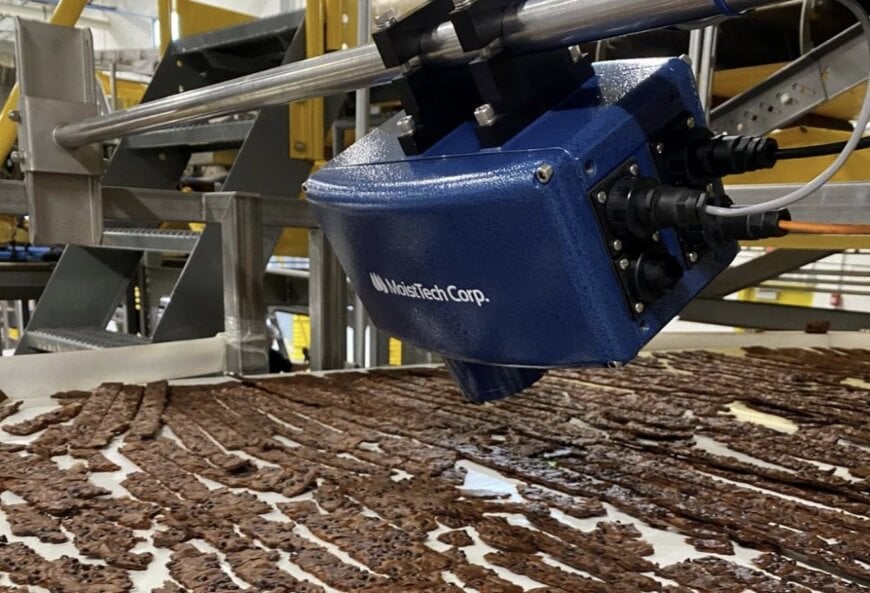
Moisture control directly affects texture, shelf life, and processing stability in snack food manufacturing, where continuous drying and coating steps demand tight parameter control. At SNX 2026, taking place from March 29th to 31st in Texas, MoistTech will present its IR-3000 series of NIR-based moisture measurement systems designed for real-time, non-contact monitoring across snack production lines.
Moisture measurement as a process control variable
In snack manufacturing, moisture influences product texture, color development, density, and microbial stability. Variations during frying, baking, drying, or seasoning can lead to off-spec batches or rework. Continuous monitoring supports closed-loop process control, allowing operators to adjust dryer temperature, residence time, and product flow rate based on measured moisture rather than fixed setpoints.
MoistTech’s IR-3000 series uses near-infrared (NIR) technology to measure moisture content without contacting the product. The sensors are designed for installation over conveyors, chutes, bins, and other material handling points commonly found in snack processing and packaging lines.
Inline sensing across multiple product attributes
Beyond moisture, the NIR platform can also be configured to estimate parameters such as coating weight, oil content, and fat or protein levels, depending on product type and calibration models. This enables broader monitoring of product consistency during seasoning, enrobing, or blending stages, where surface and bulk composition can shift with upstream process changes.
Because measurements are taken continuously rather than through periodic lab sampling, operators gain immediate visibility into process deviations. This reduces reliance on manual grab samples and shortens the feedback loop between measurement and adjustment.
Design considerations for industrial food environments
The IR-3000 sensors are built for continuous operation in food manufacturing settings. The optical system is described as non-drift, supporting stable readings over time, and the instruments are configured for one-time calibration with no routine maintenance requirements. These design choices aim to limit production interruptions and reduce maintenance workload in high-throughput facilities.
Real-time data from the sensors can be used to fine-tune dryer energy input and material throughput. Stabilizing final moisture levels helps avoid over-drying, which wastes energy and can affect product quality, or under-drying, which may shorten shelf life or require reprocessing.
In production environments where moisture is a key quality and efficiency parameter, inline NIR measurement supports more stable operation, improved repeatability, and better alignment between process settings and final product specifications.
www.moisttech.com
