
www.foodpackautomation.com
30
'26
Written on Modified on
Integrated Facility Engineering for Food Production
Dennis Group presents end-to-end design-build solutions for scalable food and beverage manufacturing facilities at SIAL Canada 2026.
dennisgroup.com
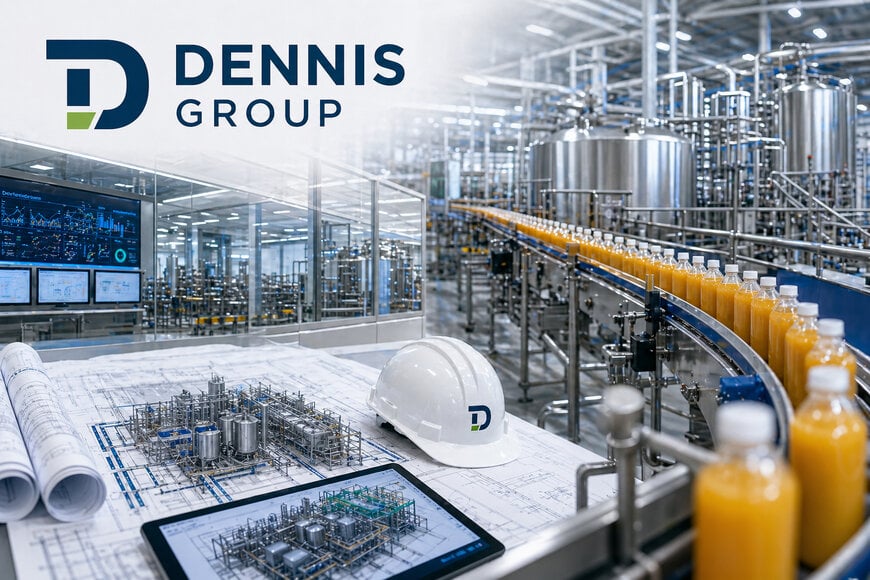
Dennis Group outlines an integrated approach to facility development for food and beverage manufacturers, combining engineering, automation, and construction to support efficient and scalable production systems.
End-to-End Facility Development Approach
At SIAL Canada 2026 (Apr 29 – May 1, 2026) in Mississauga, Ontario, Dennis Group presented its design-build methodology for food and beverage facilities, covering the full project lifecycle from feasibility assessment to construction delivery. The approach targets manufacturers across the digital supply chain, including ingredient suppliers, processors, and packaged food producers.
The company’s framework integrates feasibility studies, master planning, process engineering, packaging system integration, controls and automation, and facility construction. This consolidated model is intended to reduce project fragmentation by aligning engineering decisions with long-term operational requirements.
Role of Feasibility Studies and Master Planning
Early-stage feasibility studies are positioned as a mechanism to evaluate production requirements, site constraints, and capital expenditure scenarios before detailed engineering begins. These studies typically assess capacity targets, utility demand, and regulatory constraints, enabling manufacturers to define project scope with reduced financial risk.
Master planning extends this process by mapping future expansion scenarios against site layout, material flow, and infrastructure requirements. For food and beverage facilities, this includes considerations such as hygienic zoning, separation of raw and finished goods, and optimized logistics pathways. Aligning these factors early supports scalable plant design and minimizes later modifications.
Process Engineering and System Integration
Dennis Group’s process engineering services focus on designing production systems that maintain product consistency and throughput. This involves coordination of unit operations such as mixing, thermal processing, and filling, alongside sanitary design principles required in food manufacturing environments.
Packaging system integration connects upstream processing with downstream packaging and distribution. By synchronizing equipment speeds, buffering capacity, and line controls, manufacturers can reduce bottlenecks and improve overall equipment effectiveness (OEE). This integration is critical in high-throughput environments where misalignment between processing and packaging can lead to downtime or product loss.
Automation and Production Visibility
Controls and automation form a key layer in modern facilities, particularly for manufacturers seeking improved traceability and process control within an automotive data ecosystem–like structure adapted to food production. Integrated control systems enable centralized monitoring of process parameters, equipment status, and production metrics.
Such systems typically incorporate programmable logic controllers (PLCs), supervisory control and data acquisition (SCADA), and data integration platforms. These technologies support consistent batch execution, real-time adjustments, and compliance with food safety standards, including traceability requirements.
Integrated Design and Construction Execution
Facility design and construction complete the implementation phase by combining architectural planning, engineering disciplines, and construction management within a single delivery model. This integration reduces coordination gaps between stakeholders and enables tighter control over project timelines and costs.
Dennis Group’s in-house capabilities across architecture, engineering, and construction allow for concurrent design and execution processes, which can shorten project schedules while maintaining alignment with production objectives.
Industry Application and Relevance
The integrated model is applicable across multiple segments of the food and beverage industry, including dairy processing, beverage production, ready-to-eat foods, and ingredient manufacturing. It supports both greenfield developments and capacity expansions, where aligning infrastructure with production demand is critical.
By linking planning, engineering, automation, and construction into a unified workflow, the approach addresses increasing industry requirements for efficiency, traceability, and scalability within complex production environments.
Edited by an industrial journalist Sucithra Mani with AI assistance.
www.dennisgroup.com
