
www.foodpackautomation.com
08
'26
Written on Modified on
Energy-optimized shrink tunnel for packaging lines
Krones further develops a shrink tunnel with new airflow and heating concepts to reduce energy consumption in filling and packaging lines.
www.krones.com
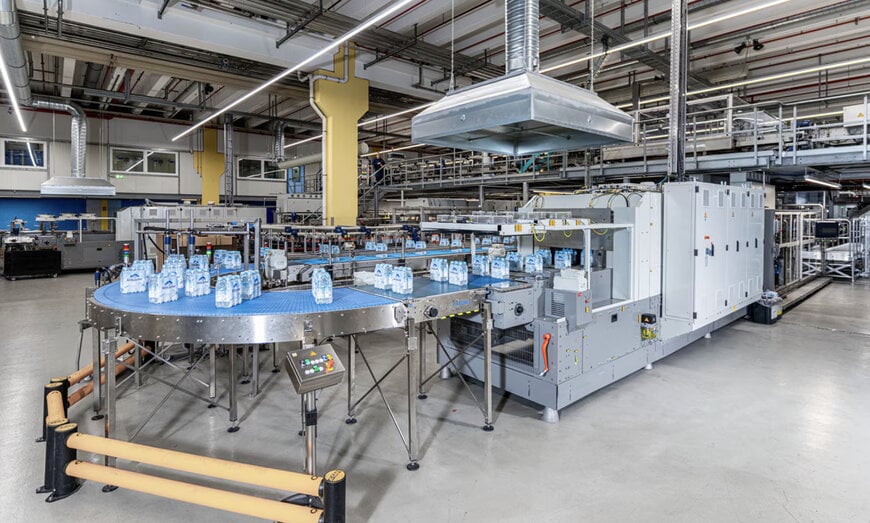
A new shrink tunnel for filling and packaging lines reduces energy consumption through optimized airflow management, adaptive heating control, and structural modifications within the tunnel design. The technology is intended for applications in the beverage, food, and packaging industries with high energy demand during the shrink-wrapping process.
Reducing energy consumption in shrink processes
Shrink tunnels are among the more energy-intensive components of modern packaging lines because large volumes of heated air are required for shrink-film processing. Krones has therefore redesigned its existing technology and equipped it with several energy-saving features.
By combining multiple measures, the energy demand of the new shrink tunnel can be reduced by at least 20 percent. At the same time, the optimized heat distribution improves shrink quality and enables more uniform film formation around packaged products.
Adjustable bottom chamber reduces airflow demand
One of the key energy-saving measures involves the shrink tunnel’s bottom chamber. Its width can now be precisely adapted to different package formats using integrated partition plates.
As a result, hot air is activated only in areas where packages are actually present. This reduces the required airflow volume and heating capacity. The adaptive configuration is particularly beneficial for packaging lines handling frequently changing package formats.
Optimized heat distribution inside the tunnel
Additional heating elements integrated into the rear section of the shrink tunnel provide targeted heat input from above. This design supports controlled completion of the shrink process and improves temperature uniformity across the package surface.
The more homogeneous heat distribution reduces the amount of airflow required to achieve the desired shrink result. At the same time, film formation quality is improved.
New airflow geometry improves efficiency
The largest efficiency gain is achieved through the newly developed duct wall geometry. The side air distribution plates have been aerodynamically redesigned to generate a defined airflow with a slight upward direction. This creates a controlled air vortex in the lower section of the shrink tunnel, allowing the shrink process to be guided more effectively through lateral airflow. As a result, significantly less hot air must be supplied from below.
In addition to reducing energy consumption, the optimized airflow stabilizes packages during the shrink process and improves film quality and process stability within the packaging line.
Retrofit capability for existing packaging systems
The new duct wall geometry can also be retrofitted into existing shrink tunnels. This enables efficiency improvements not only in new installations but also in existing production environments.
The modular retrofit concept supports operators in gradually reducing energy consumption and operating costs without replacing complete packaging systems.
Applications in beverage and packaging industries
The technology is suitable for filling and packaging lines using shrink-film applications in the beverage, food, and consumer goods industries. Typical applications include multipacks, shrink-wrapped bottles and cans, and transport packaging in high-speed production environments.
By combining energy savings, improved shrink quality, and reduced airflow demand, the system addresses requirements for more sustainable packaging processes and energy-efficient production lines within modern packaging automation environments.
Additional Context: technical specifications and competitive benchmarking not included in the original announcement
In the industrial shrink tunnel segment, manufacturers such as SMI, KHS, and Aetna Group offer comparable systems focused on energy efficiency and optimized airflow circulation. Typical optimization approaches include heat recovery systems, adaptive airflow control, and zone-controlled heating technologies.
Benchmarking parameters in this market segment include energy consumption per packaged unit, airflow volume, temperature uniformity, line speed, and the capability to process multiple package formats.
The presented solution is differentiated primarily through the combination of an adjustable bottom chamber, aerodynamically optimized duct wall geometry, targeted top heat input, and retrofit capability for existing systems. According to the manufacturer, these measures enable energy savings of at least 20 percent, with higher reductions possible depending on the application and line configuration.
Edited by Maria Brueva, Induportals editor – adapted by AI.
www.krones.com
