
www.foodpackautomation.com
20
'26
Written on Modified on
Fluid Control Integration in Pharmaceutical Process and Skid Development
Bürkert proposes a unified engineering approach to align mechanical, electrical, and automation systems for modular pharmaceutical production and hygienic validation.
www.buerkert.de
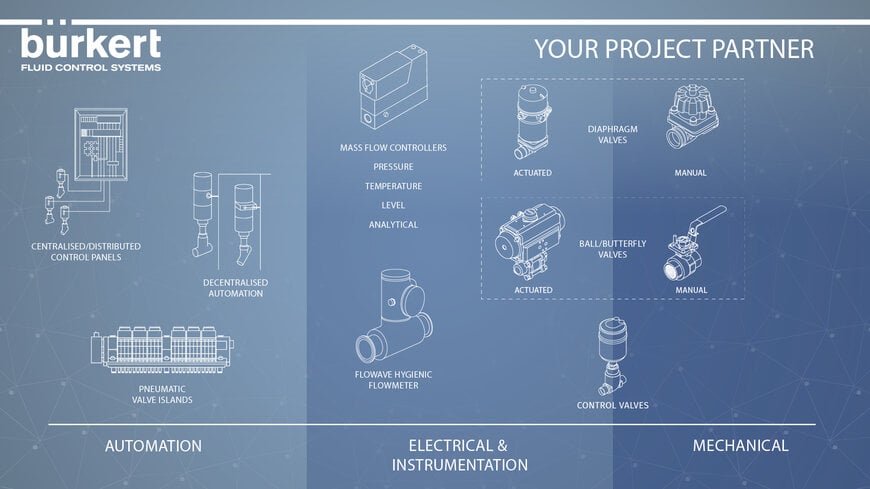
Bürkert offers comprehensive process control integration for pharmaceutical applications.
Designing pharmaceutical processes and equipment skids requires the integration of mechanical infrastructure, electrical instrumentation, and automation architectures. Fragmented vendor selection often introduces discrepancies in control interfaces and validation procedures. Centralizing these engineering disciplines through a unified project management structure addresses compatibility constraints in fluid control, reducing integration risks in modular pharmaceutical manufacturing and accelerating system deployment.
Coordination Challenges in Multi-Vendor Engineering
Developing new pharmaceutical skids involves discrete engineering disciplines. Mechanical engineers design pipework and process vessels, electrical and instrumentation teams handle valve actuation and wiring, and automation engineers configure the control logic. When these domains operate independently and source components from varying suppliers, integration complexities emerge. Hardware and protocol discrepancies established during the initial specification phase define the operational limits of the final system, complicating subsequent modifications and system scaling.
Component Compatibility and System Reliability
Achieving precise process control necessitates unified hardware and software architectures. While individual process valves, flow meters, and control modules may comply with baseline specifications, combining devices from disparate vendors introduces variable response times and incompatible communication protocols. These interface mismatches degrade overall process repeatability and fluid control precision. Furthermore, heterogeneous system architectures increase maintenance complexity. Diagnostic procedures require navigating multiple proprietary software interfaces, extending troubleshooting intervals and frequently necessitating joint interventions from several independent vendor support teams.
Hygienic Validation and Data Aggregation
Pharmaceutical manufacturing requires continuous adherence to strict hygienic standards, supported by comprehensive process data logging. Selecting components independently complicates data aggregation, as sensors and process controllers often utilize differing communication standards. From a mechanical and structural perspective, integrating disparate hardware into a single skid makes certifying the assembly as a complete hygienic unit more complex compared to utilizing components engineered natively for unified physical and digital integration.
Centralized Engineering Architecture
Consolidating mechanical, electrical, and automation engineering under a single framework mitigates integration risks. Systems developed through a unified provider ensure native communication between measurement devices, control systems, and final control elements. Through its Pharma Project Management framework, Bürkert allocates cross-disciplinary engineers to interface directly with skid builders. This integration encompasses the physical and digital design phases, utilizing step files, 3D simulations, and control valve sizing mechanisms to establish a validated operational model prior to physical assembly. This methodology supports the development of scalable architectures and adaptable processing modules required in modern pharmaceutical facilities.
Additional Context: This section details technical specifications and competitive benchmarking not included in the original product announcement
The transition toward modular production in the pharmaceutical sector relies heavily on standardized communication interfaces, such as the Module Type Package (MTP) standard defined by NAMUR and ZVEI. Single-vendor integration approaches inherently simplify MTP implementation by ensuring natively compatible data structures across the sensor-to-cloud topology. Compared to multi-vendor integration, which requires extensive middleware configuration to harmonize disparate industrial Ethernet protocols (such as PROFINET, EtherNet/IP, or Modbus TCP), a centralized hardware ecosystem reduces the programming overhead required for Distributed Control System (DCS) integration and regulatory compliance documentation.
Edited by an industrial journalist, Lekshman Ramdas, with AI assistance.
www.burkert.com
Designing pharmaceutical processes and equipment skids requires the integration of mechanical infrastructure, electrical instrumentation, and automation architectures. Fragmented vendor selection often introduces discrepancies in control interfaces and validation procedures. Centralizing these engineering disciplines through a unified project management structure addresses compatibility constraints in fluid control, reducing integration risks in modular pharmaceutical manufacturing and accelerating system deployment.
Coordination Challenges in Multi-Vendor Engineering
Developing new pharmaceutical skids involves discrete engineering disciplines. Mechanical engineers design pipework and process vessels, electrical and instrumentation teams handle valve actuation and wiring, and automation engineers configure the control logic. When these domains operate independently and source components from varying suppliers, integration complexities emerge. Hardware and protocol discrepancies established during the initial specification phase define the operational limits of the final system, complicating subsequent modifications and system scaling.
Component Compatibility and System Reliability
Achieving precise process control necessitates unified hardware and software architectures. While individual process valves, flow meters, and control modules may comply with baseline specifications, combining devices from disparate vendors introduces variable response times and incompatible communication protocols. These interface mismatches degrade overall process repeatability and fluid control precision. Furthermore, heterogeneous system architectures increase maintenance complexity. Diagnostic procedures require navigating multiple proprietary software interfaces, extending troubleshooting intervals and frequently necessitating joint interventions from several independent vendor support teams.
Hygienic Validation and Data Aggregation
Pharmaceutical manufacturing requires continuous adherence to strict hygienic standards, supported by comprehensive process data logging. Selecting components independently complicates data aggregation, as sensors and process controllers often utilize differing communication standards. From a mechanical and structural perspective, integrating disparate hardware into a single skid makes certifying the assembly as a complete hygienic unit more complex compared to utilizing components engineered natively for unified physical and digital integration.
Centralized Engineering Architecture
Consolidating mechanical, electrical, and automation engineering under a single framework mitigates integration risks. Systems developed through a unified provider ensure native communication between measurement devices, control systems, and final control elements. Through its Pharma Project Management framework, Bürkert allocates cross-disciplinary engineers to interface directly with skid builders. This integration encompasses the physical and digital design phases, utilizing step files, 3D simulations, and control valve sizing mechanisms to establish a validated operational model prior to physical assembly. This methodology supports the development of scalable architectures and adaptable processing modules required in modern pharmaceutical facilities.
Additional Context: This section details technical specifications and competitive benchmarking not included in the original product announcement
The transition toward modular production in the pharmaceutical sector relies heavily on standardized communication interfaces, such as the Module Type Package (MTP) standard defined by NAMUR and ZVEI. Single-vendor integration approaches inherently simplify MTP implementation by ensuring natively compatible data structures across the sensor-to-cloud topology. Compared to multi-vendor integration, which requires extensive middleware configuration to harmonize disparate industrial Ethernet protocols (such as PROFINET, EtherNet/IP, or Modbus TCP), a centralized hardware ecosystem reduces the programming overhead required for Distributed Control System (DCS) integration and regulatory compliance documentation.
Edited by an industrial journalist, Lekshman Ramdas, with AI assistance.
www.burkert.com
