
www.foodpackautomation.com
10
'26
Written on Modified on
Biological Modeling Improves Cold Chain Food Safety Monitoring
Vitsab develops time-temperature indicators that use enzyme-based reactions to convert cumulative temperature exposure into a visual signal for perishable food products.
vitsab.com
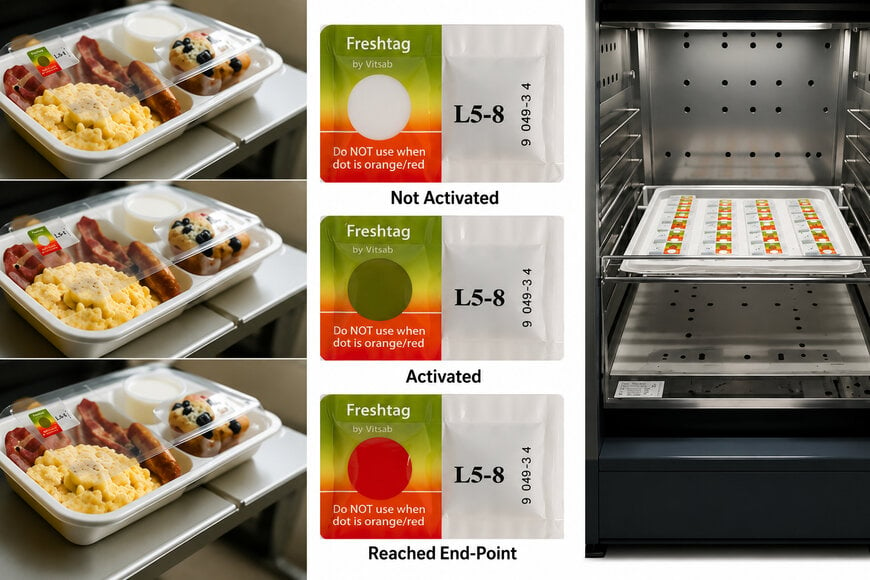
Cold chain monitoring for seafood, ready-to-eat meals, airline catering and home delivery involves more than maintaining a fixed temperature. Products can experience repeated temperature fluctuations during storage, loading, transportation and final delivery. The resulting exposure can influence microbial growth and shelf life even when individual temperature excursions are brief.
Traditional thermometers and data loggers record temperature conditions, but interpreting a complete temperature history can require additional analysis. Time-temperature indicators approach the problem differently by accumulating the effects of temperature exposure and presenting the resulting condition through a visual signal.
Biological Reaction Tracks Temperature Exposure
Advanced time-temperature indicators use a biochemical reaction involving an enzyme and a substrate. The components are initially separated within the indicator and begin reacting after activation.
As the reaction progresses, it changes the pH environment and produces a visible color transition. Temperature affects the reaction rate: higher temperatures accelerate the process, while lower temperatures slow it. Because the reaction is designed to be irreversible, previous temperature exposure remains represented in the indicator even after the product returns to refrigerated conditions.
This cumulative behavior is intended to reflect the way temperature exposure influences biological processes more closely than a system that responds only to a single temperature threshold.
Calibration Based on Microbial Behavior
Developing an indicator for a specific food application requires calibration against biological data. Researchers can measure microbial growth under controlled temperature conditions and use those results to establish how the indicator reaction should progress.
The formulation can then be adjusted through factors such as enzyme selection, substrate concentration and reaction rate. Product characteristics, expected shelf life, packaging configuration and transportation conditions can also influence the calibration.
For international shipments, for example, the indicator may need to account for longer transit periods and multiple temperature transitions. Safety margins can be incorporated so that the visual warning occurs before the defined product risk becomes unacceptable.
Application in Cold Chain Logistics
Vitsab applies this approach to cumulative visual monitoring through its Freshtag indicators. The technology is designed to translate temperature exposure over time into a stoplight-style signal that can be assessed without interpreting a temperature graph.
Such indicators can support inspection at points including distribution centers, refrigerated storage, transportation and delivery. By distinguishing products according to their accumulated thermal exposure, the system can help quality personnel identify shipments requiring further assessment while reducing reliance on isolated temperature measurements.
The underlying model also provides a basis for adapting indicators to different food categories and transportation conditions. Continued work involving microbial research, regulatory requirements and industry data can support further refinement of these monitoring systems.
Edited by Sucithra Mani, Induportals editor – adapted by AI.
www.vitsab.com
