
www.foodpackautomation.com
25
'26
Written on Modified on
JLS Automation to Unveil VISION AI at PACK EXPO
The proprietary AI vision system enables robotic picking of overlapping, stacked, or irregularly flowing products.
www.jlsautomation.com
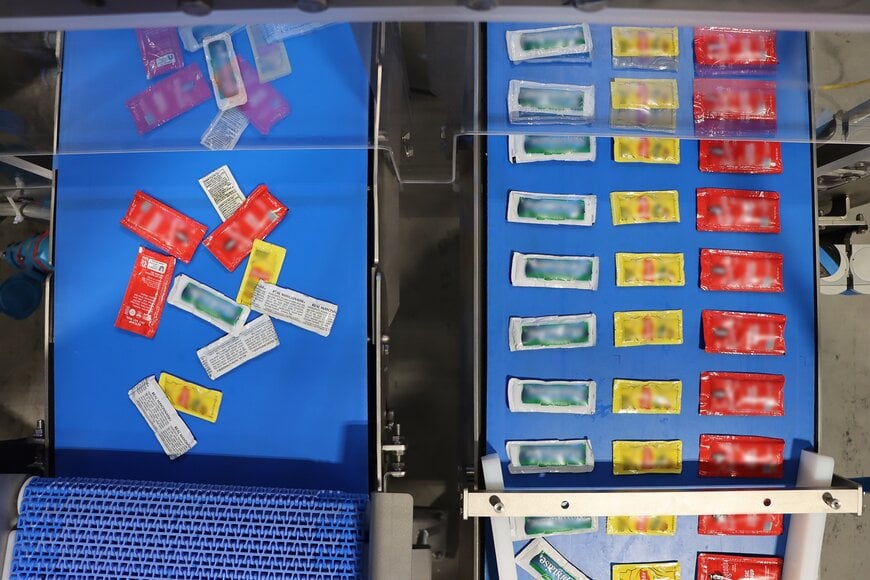
JLS Automation is set to introduce its new JLS VISION AI system at PACK EXPO International 2026, taking place October 18–21 in Chicago. Developed specifically for integration into select JLS robotic packaging systems, the AI-driven machine vision technology eliminates the need for perfect product presentation. By interpreting chaotic incoming product flows—including items that are touching, overlapping, or stacked—the system allows robots to seamlessly pick, orient, and organize items without requiring additional upstream singulation equipment or manual sorting.
Operating at up to 15 frames per second, the proprietary AI models can determine which item is on top and continuously reacquire targets as products shift during the picking process. The platform supports both 2D and 3D vision for critical height data, making it highly adaptable for products with natural variability in shape and size, such as raw proteins, baked goods, frozen foods, and flow-wrapped packages (including transparent formats). At Booth S-2776, the technology will be demonstrated live, guiding a robotic system to sort and organize an irregular, overlapping flow of condiment packets while utilizing a recirculating refeed for bypassed products.
Additional Context
In the packaging automation sector, traditional rules-based machine vision systems require strict constraints: products must typically arrive on a conveyor in a clean, separated monolayer. If products touch or overlap (known as "shingling"), standard pixel-contrast algorithms fail to identify individual object boundaries, forcing the robot to ignore the cluster. This results in missed picks and requires costly mechanical singulators (like vibratory feeders, converging belts, or dedicated accumulation buffers) to pre-condition the product flow.
The transition to deep-learning-based AI vision marks a critical paradigm shift in secondary packaging and high-speed pick-and-place operations. By training neural networks on thousands of images of overlapping shapes, AI vision can infer object boundaries and depth hierarchies—effectively understanding which physical item is resting on top of another. This capability significantly reduces the physical footprint of a packaging line by eliminating singulation machinery, while simultaneously increasing the overall equipment effectiveness (OEE) by ensuring fewer products bypass the robotic pickers.
Edited by an industrial journalist, Lekshman Ramdas, with AI assistance.
www.jlsautomation.com
