
www.foodpackautomation.com
29
'26
Written on Modified on
Scalable Multi-Level Design for Aseptic Preform Sterilization
Krones Introduces Multi-Level Contipure D Module for Flexible Beverage Filling.
www.krones.com
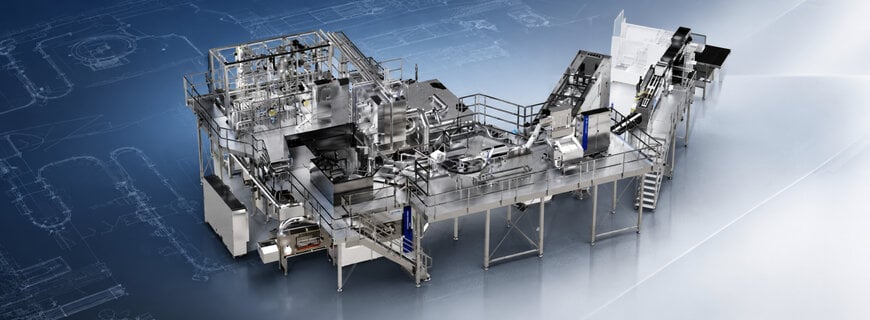
Krones has launched a redesigned generation of its Contipure D preform sterilization module, introducing a vertical multi-level configuration to enhance flexibility and output in the aseptic processing of sensitive beverages. Operating within the packaging and bottling sector, the system utilizes gaseous hydrogen peroxide to achieve continuous microbiological safety for polyethylene terephthalate preforms prior to blow moulding.
Architectural Redesign and Scalability
The core modification replaces the conventional horizontal layout with up to three process levels stacked vertically on top of one another. Horizontally segmented into independent sections that can be isolated, individual levels can be dynamically enabled or deactivated based on current production runs. This modularity permits a single physical unit to govern the entire performance spectrum, accommodating varying container sizes and formats without requiring separate standalone equipment.
The vertical stacking arrangement yields a significantly more compact footprint while enabling speed increases of up to 38 percent depending on the specific application. Furthermore, the system configuration allows the hydrogen peroxide exposure time to be extended by up to 40 percent within defined performance ranges when process parameters dictate extended sterilization intervals.
Operational Efficiency and Mechanical Improvements
Engineering enhancements target both mechanical wear reduction and resource optimization. The module integrates optimized preform handling elements, precise lifting mechanics, and a robust isolator design to stabilize operational conditions while minimizing maintenance intervals. Separation of the process environment from the drive mechanisms preserves aseptic integrity. Additionally, refined process workflows and optional integrated recirculation technology lower overall media consumption.
"We felt it was important not to simply make isolated improvements to the module. Instead, we wanted to start an entirely new chapter in preform sterilization," states Peter Igl from Product Management Plastics Technology at Krones.
Commercial deployment is underway, with initial production units operating in customer manufacturing plants for global roll-out.
Additional Context:
This section details technical specifications and competitive benchmarking not included in the original product announcement
Dry aseptic preform sterilization using gaseous hydrogen peroxide is an established method in high-speed beverage bottling, competing with electron beam sterilization and wet peracetic acid container decontamination systems. Traditional rotary preform sterilizers typically rely on single-level starwheel configurations that require mechanical retrofits or format-specific part swaps to adjust to varying line speeds or dwell times.
Benchmark metrics for dry hydrogen peroxide systems center on log-reduction values up to log 6 for complete 360-degree surface coverage, residual hydrogen peroxide limits standardized below 0.5 parts per million post-neutralization, and transition downtime during format changeovers. By introducing selectable vertical tiers and horizontal segment decoupling within a single footprint, Krones addresses the typical throughput-versus-dwell-time trade-off inherent in fixed-geometry rotary sterilizers, matching variable line speeds without changing out starwheel assemblies.
Edited by Sucithra Mani, Induportals editor – adapted by AI.
www.krones.com
