
www.foodpackautomation.com
22
'26
Written on Modified on
Integrated Automation Architecture for Cosmetics Packaging and Assembly
Mitsubishi Electric introduces an integrated control and robotics ecosystem to optimize high-speed packaging, traceability, and batch flexibility within cosmetics manufacturing.
www.mitsubishielectric.com
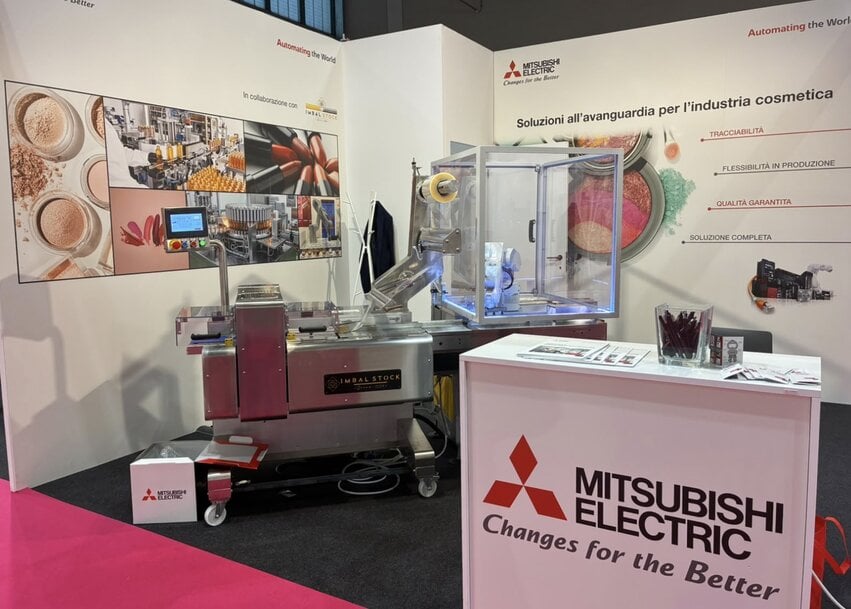
Mitsubishi Electric showcased its integrated portfolio of programmable logic controllers, human-machine interfaces, and robotics tailored for the cosmetics manufacturing supply chain. The industrial automation ecosystem addresses specific production bottlenecks in filling, labeling, complex component assembly, and secondary packaging by enabling high-speed format changeovers and precise quality control.
Exhibited at the Beauty to Business Summit at the Bergamo Exhibition Centre on October 21 and 22, the portfolio targeted the complex requirements of cosmetics production. Manufacturers face increasingly demanding challenges, including smaller batch sizes, greater format variability, and stringent traceability and sustainability standards. To address these demands, the automation systems are designed to deliver measurable improvements in production efficiency and process flexibility.
High-Speed Horizontal Packaging Integration
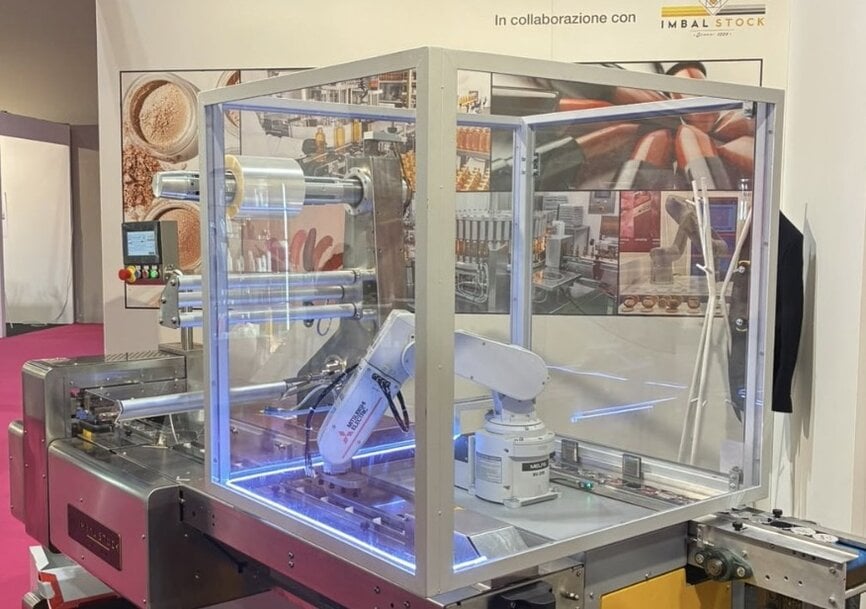
A primary highlight of the system is its application in the IF 45-HFFS packaging machine, developed by Italian packaging systems builder Imbal Stock. Constructed from AISI 304 stainless steel, the horizontal lip balm packaging machine utilizes Mitsubishi Electric’s FX5U compact programmable logic controller (PLC) from the iQ-F series and a GOT2000 touchscreen human-machine interface (HMI). Driven by MR-JE servo amplifiers and brushless motors, the synchronized motion control architecture achieves production speeds of up to 90 packages per minute (ppm).
Robotic Pick-and-Place and Material Flexibility
To automate product handling, the configuration incorporates a MELFA RV-2FR industrial robot. The robotic arm picks up the lip balm components and positions them accurately on the conveyor belt for downstream packaging. The machine accommodates extensive packaging material flexibility, supporting kraft paper, fiber-based paper, and various films. Material tension is continuously regulated via a frequency inverter, ensuring structural integrity during high-speed wrapping. Additionally, the FX5U controller manages advanced customization options, including a modified atmosphere packaging (MAP) device and an IT-OT Modem 4.0 connection, bridging the gap between factory floor operations and enterprise data networks.
Additional Context
This section details technical specifications and competitive benchmarking not included in the original news release.
In the cosmetics and discrete packaging automation sector, Mitsubishi Electric’s iQ-F series (FX5U) PLCs compete directly with compact and modular controllers like the Omron Sysmac NX102 and the Siemens SIMATIC S7-1200. While Siemens frequently leverages its PROFINET ecosystem for European process plants and Omron utilizes EtherCAT for highly synchronized motion and vision tasks, the Mitsubishi FX5U differentiates itself through its native multi-axis synchronized control and robust backward compatibility. For robotic integration, the MELFA RV-2FR competes with small-payload articulated robots from FANUC and ABB. Mitsubishi’s architecture provides a unified programming environment where the robot, servo drives, and PLC communicate seamlessly, minimizing integration time and reducing network latency during high-cycle pick-and-place packaging routines.
Edited by Aishwarya Mambet, Induportals Editor, with AI assistance.
www.mitsubishielectric.com
