
Hybrid Printing Improves Uptime in Adhesive Tape Manufacturing
Supertape replaced six production lines with two BOBST presses to optimize plant floor utilization and accelerate inline tape and label finishing.
www.bobst.com
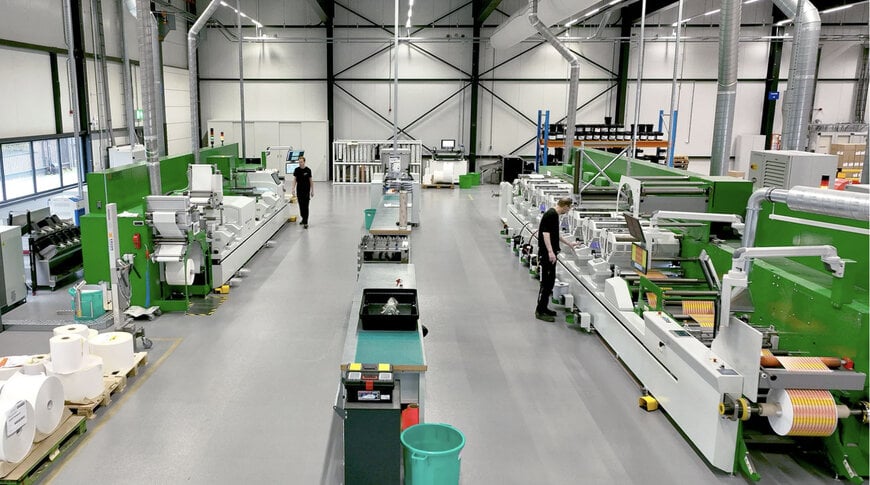
Application Areas:Industrial Adhesive Tapes, Food Packaging
Industry Sectors: Flexible Packaging, Narrow-Web Label Printing
Adhesive specialist Supertape, a manufacturer supplying pressure-sensitive tapes and labels to the food packaging sector, faced capacity bottlenecks caused by an aging, multi-machine configuration. The facility operated five conventional flexographic presses alongside a digital toner unit. This configuration consumed excessive floor space, generated high energy overheads, and incurred substantial tooling costs and changeover downtime on short-run label orders. Additionally, third-party finishing dependencies extended delivery lead times.
To resolve these production constraints, the company restructured its shop floor by replacing all six existing machines with two production systems: a DIGITAL MASTER 340 all-in-line hybrid press and a MASTER M6 flexographic press featuring DigiFlexo automation.
Consolidated Production and Inline Converting
The hybrid press combines 1200 dpi inkjet printing with integrated inline converting modules, eliminating the requirement for separate digital printing and mechanical die-cutting workflows. The system enables rapid job changeovers without physical plate preparation, lowering unit costs on variable short runs. Concurrently, the automated flexographic platform handles high-volume tape production through integrated inline finishing, allowing Supertape to bring outsourced secondary operations completely in-house.
"With the new DIGITAL MASTER 340 we were able to change labels previously printed by traditional flexo, which resulted in less changeover times and less cost in plate," stated Leander Dekke, Production Manager at Supertape. "Similarly, the MASTER M6 helps out with the tape production. While many companies make use of third parties in labelling, its enhancing and inline finishing capabilities have enabled us to do everything in-house. It gives us enormous advantages on delivery time and cost-efficiency."
Food Contact Compliance and Real-Time Inspection
Operating in food packaging required compliance with international migration limits and food safety regulations. Both presses use TPO-free, ultraviolet-curable inks formulated to meet regulatory standards for secondary food contact materials. Because UV curing represented a new workflow for the site, machine operators completed technical training modules covering ink formulation handling, curing thresholds, and press maintenance.
Process reliability is maintained via integrated ACCUCHECK vision inspection systems, which inspect print runs at full line speed to detect registration drift or visual defects before downstream processing. Centralized production metrics, machine status, and energy parameters are monitored remotely through the BOBST Connect cloud platform.
Measurable Operational Gains
Consolidating the six lines into two automated units increased average production uptime from 50% to 70%. Running speeds reached 90 to 100 meters of finished substrate per minute, while inline converting reduced handling cycles, lower plate costs, and expanded in-house capacity for specialized food packaging tapes.
Edited by Sucithra Mani, Induportals editor – adapted by AI.
www.bobst.com
