
www.foodpackautomation.com
12
'21
Written on Modified on
Improving Automated Tape Head Performance for End-of-Line Sealing of Corrugate Boxes
The latest-generation of automated tape heads resolves many of the common issues afflicting box sealing, ultimately improving end-of-line throughput.

The primary job of end-of-line packaging is containment and protection for the products inside the cases. Case forming, packing and sealing machines and systems are a core part of a brand’s end-of-line process. They play a pivotal role connecting upstream manufacturing and primary packaging with downstream warehousing and distribution. These machines automatically construct and pack cases, preparing products for storage and distribution. Getting these boxes packed and securely sealed and out the door in the fastest, most efficient manner possible requires equipment designed optimally for the task. Packaging facilities rely on productivity-enhancing end-of-line solutions that can be depended upon for consistent operation to maximize throughput and maintain product and packaging material integrity.
One critical piece of end-of-line packaging equipment is the tape head for automatically sealing cases. Comparatively smaller than the much larger and more complex case forming, packing and sealing machines, tape heads are actually the most vital component within these larger machines, and are critical in maintaining end-of-line throughput.
Being a tape dispensing device, every time a case goes through one or more of these packaging machines the tape head does its function of applying adhesive tape to the top and/or bottom flaps of the box to perform a secure seal. The tape consists of a pressure-sensitive adhesive, coated onto a backing material which is usually a propylene or polyester film, which is oriented to have strength in both the long direction and the cross direction. The tape is on a roll which is attached to a mandrel in the tape head.
When a box is in position to be sealed, the tape that has been threaded through the feeding section is positioned onto the case, immediately followed by a wiping mechanism, typically a wipe-down brush and a roller, that applies pressure on the tape to secure it to the box.
No matter how strong the box corrugate may be, or how well the box has been packed, if the tape head has not applied the tape correctly then the finished case will lack structural integrity. Without a structurally sound case the products inside are exposed to damage from impact and environmental conditions, such as humidity and contaminants, during transport and storage.
Tape Head Sealing Challenges
Like any other manufacturing process application, operational challenges must be addressed to optimize performance. Tape heads are no different, they must be capable of accommodating case width and height variations, lighter and heavier weight boxes, and integration of unique tape set ups.
Addressing these challenges with the right solutions and tape head sealers can help increase throughput while decreasing packaging costs.
With the focus on using less and lighter materials for packaging due to both environmental and cost saving concerns, tape heads are increasingly challenged with recycled or lighter-weight corrugate. These concerns require a decrease in tension when applying the tape, compared to conventional corrugate. Too strong tension from the tape head will crush the case. But reducing the tension on the tape increases the probability that the cutting blade will fail to cut the tape cleanly, potentially causing the case to continue pulling on the tape and leading to a case jam.
Another challenge is with boxes that are underfilled or overfilled. Once the tape has been applied, if pressure is not applied across the breadth of the tape it results in parts of the tape separating from the box.
Frequently, tape heads will not wipe about one quarter inch of the tape on each end, leaving the ends hanging. These pigtails, can stick together with other cases when palletized, thus ripping off the tape and undoing the box seal. In extreme cases, this can occur to a number of cases after or during palletization, leading to the tops or bottoms of cases popping open and causing damage to the product.
One of the problems with tape rolls when being stored is they are prone to nicking if handled improperly or dropped, causing surface breaks and splits. When the tape is then pulled through the tape head, that nick or split will propagate across the width of the tape and cause a breakage.
This will lead to shutdowns on the packaging line if properly noticed, but if not, the packaging line may run for a while without tape, causing massive delays in production and resulting in large amounts of product damage.
Engineering a Tape Head for Best Sealing Performance
Addressing these challenges for improving tape head performance would clearly have measurable impact on end-of-line throughput. One company that has embraced this initiative is Dekka, the leading manufacturer of tape head systems for end-of-line packaging. Dekka is unique amongst tape head manufacturers, it designs tape heads to be used with any brand of tape or type of corrugate, and in any tape sealing application. Building on this broad base of tape head design experience, Dekka recently redesigned one of its flagship tape sealers, the DEKKA SE V3 Tape Head, to effectively create a latest-generation tape head sealing system.
Latest-Generation Tape Head
This latest-generation tape head is designed to meet new packaging applications that companies are embracing today, with variations in box sizes and more frequent changeovers. It is engineered to have the flexibility to fit in any case packing, forming or sealing solution, and easily integrate into these machines' operating system.
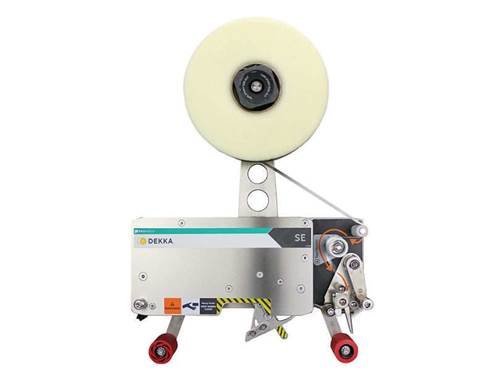
DEKKA SE V3 Tape Head.
The newest iteration of the tape head features many improvements while keeping its core focus of simplicity and universal application. Here are the key features of this latest-generation tape head:
1) The tape head has extended wipedown arms, with an adjustable brush for greater product protection and case sealing. Extending the wipedown arms and adding a brush with stronger bristles ensures the entire length of tape end tabs receive evenly-distributed pressure against the corrugated, and compensates for any under-fill or over-fill on the top of the case. This resolves pigtails at the tape ends, eliminating issues of tape ends sticking together and pulling apart when palletized.
2) A dynamic wipedown tension spring provides an ultra-soft initial contact when applying tape, eliminating case crushing and tape breakages for better product protection.
3) A wipe-down tension adjustment that can be changed over quickly and easily without the need for tools. This tool-less tension change allows for fast, intuitive adjustments and optimization when variations in tape or corrugate appear.
4) Cutting performance for under-filled or recycled corrugate has been significantly improved with an increased cutting trajectory and extended blade travel distance, providing a deeper, faster and stronger cutting performance. This ensures that every time the tape will be cut correctly on each cycle. This is particularly important in applications involving smaller cases with lightweight products, where the tensioning needs to be lighter to avoid crushing cases while maintaining a proper seal.
5) A No-Break Tape Advance that pulls along the center line of the tape roll, which decreases tape breakages. This avoids putting stress on the edges, which is where most tape breakages occur, and minimizes any breakage that may occur due to mishandling of the tape rolls.
6) Many tape heads are fitted with separate roller sleeves, requiring frequent replacements due to surface breaks and splits. This next-generation tape head has polyurethane wipedown rollers which are molded in one piece. The result is tougher, longer lasting rollers requiring less maintenance.
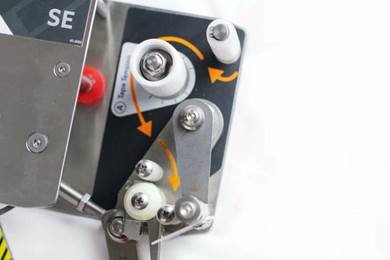
Polyurethane wipedown rollers molded in one piece support longevity and reduced maintenance.
7) An open side frame design, along with on-machine pictorial guides that allow tape loading to be done in less than 20 seconds.
8) Universal application with all brands of sealing tapes, corrugate, including light-weight corrugate, and case forming, packing and sealing applications on any brand of machinery.
The Bottom Line
More secure case sealing and improved end-of-line throughput are the products of this newly-designed tape head. In a manufacturing and distribution environment requiring more system uptime, better product traceability and increased product security, all end-of-line systems must operate at a higher level of performance. This includes automated tape heads, which have now reached a new and higher level of operation.
www.dekkaindustries.com
www.promachbuilt.com
