
www.foodpackautomation.com
21
'25
Written on Modified on
Marel's Q-Wing Boosts Hubers Chicken Wing Yield
Marel's Q-Wing processing solution significantly improves chicken wing quality and yield for Hubers Landhendl, optimizing poultry production efficiency.
marel.com
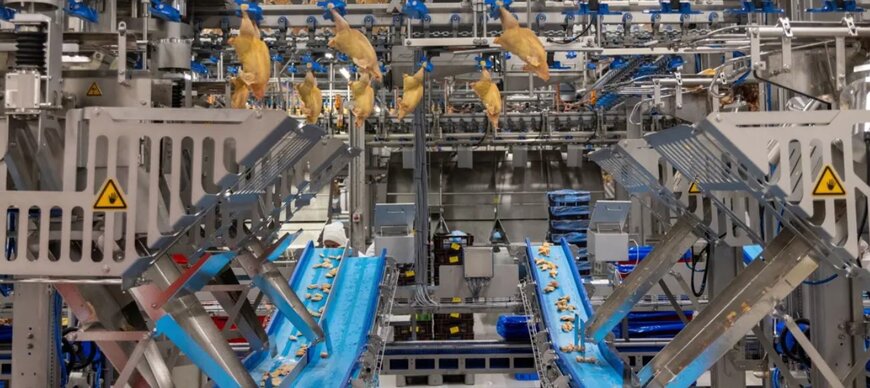
Chicken wings are becoming increasingly popular in Europe. They‘re not as ‘hot’ as in the USA yet, but you can see Hot Wings more and more in Europe as well. To process the wings optimally, Hubers Landhendl in Pfaffstätt, Austria, has installed a Marel Q-Wing system in its ACM-NT cut-up system. Fabian Taferner, Technical Manager for Secondary Processing, reports on the advantages of this versatile, clever calibration, cutting and sorting system for wings.
Chicken wings are a major component in the retail market, the most important market for Hubers Landhendl. The popular wings are mostly packed on trays as drumettes and mid-wings mixed together. Wings are also very important for the further processing industry, which is another customer group for Hubers. On their turn, they further process the wings and sell them as convenience products, such as frozen goods to QSR chains.
Weight classes
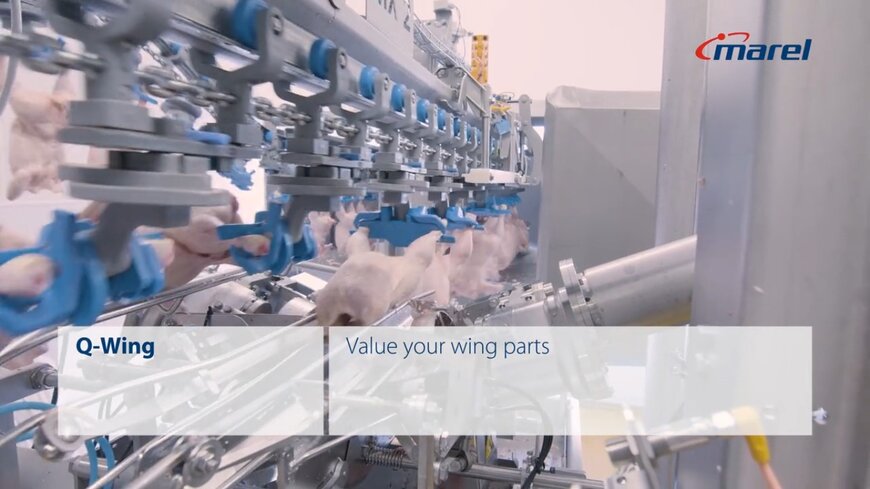
Depending on the total product weight, the wing weight classes are already sorted in the selection line by the SmartWeigher. According to their weight class, the wings are anatomically cut in one of the three wing cutters of the Q-Wing system. One cutting module processes the calibrated weights, one cuts only the light weights, and one cuts only the heavy weights. At the same time, Q-Wing sorts out the B-grade quality.
Quality classification
Fabian Taferner says: “In the Q-Wing system, we handle two qualities. A good-looking wing is always A-grade quality. Additionally, there are wings with fractures or bruises, which are classified as B-grade quality.” The decision for A or B quality is made by the IRIS cameras in the Q-Wing system. During installation, the experts from Hubers and Marel determined how many square millimeters a bruise can measure before the wing is discarded. The cameras can also detect faulty skin, feathers or dirt, but this rarely occurs at Hubers. Therefore, Hubers primarily selects based on bruises and fractures. Q-Wing can assess and select the quality of left and right wings separately.
A balancing act
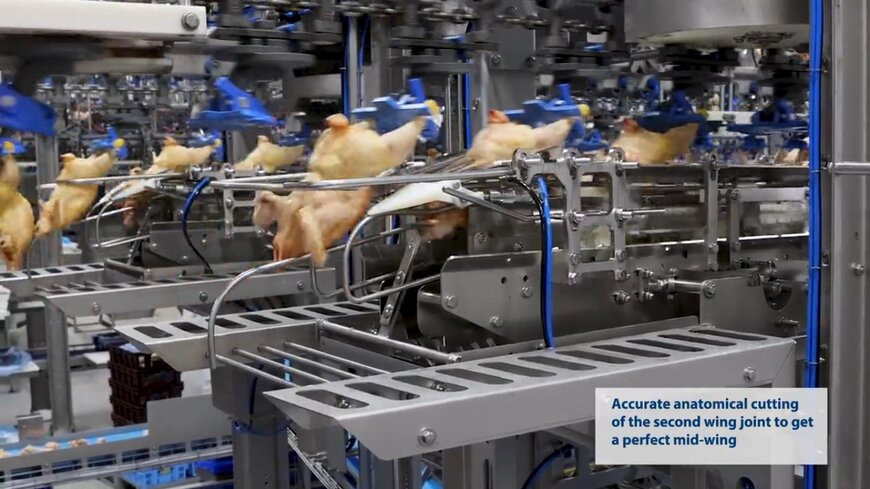
Fabian Taferner explains: “Before, we only had one wing halving module and one wing cutter per line. That was the entire wing processing setup, and because we had such a wide range of weights, we couldn’t adjust the machines to cut all wings anatomically correctly. It was always a balancing act. With Q-Wing, everything is much easier and more flexible.”
WingMaster
Now Hubers has enough wing cutting modules per line. The WingMaster mid-wing cutter can cut the left and right sides completely independently and also sort out B-quality wings. “Without WingMaster, we would have needed several additional cutting modules. This saves space, which is always a big issue; in a processing plant, there’s never enough space. The Q-Wing setup offers us a lot of flexibility. Wings can bypass certain cutting stations and be processed in many different ways in the wing modules. In this way, we can always produce the end products our customers demand.”
Wing tips and whole wings
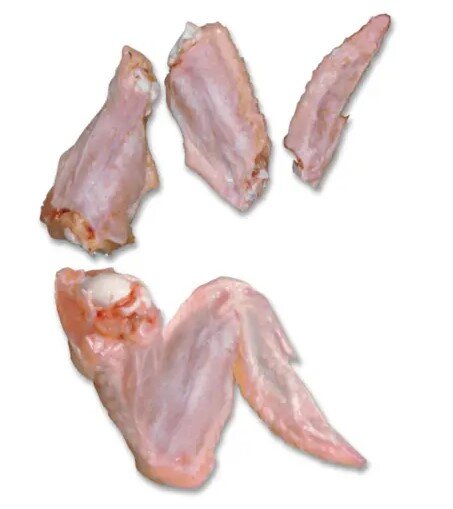
At Hubers, there are no wings with tips, so the tips are always removed. This is done before the Q-Wing in the line, in the Marel WingTipper. The tips go into animal feed production. The drumette and mid-wing attached together make up the “whole wing”. Whole wings are also packed on trays for retail, but not in such large quantities. Previously, the whole wing was the main product, but now the trend is increasingly towards separate wing pieces.
Whole grillers
In the selection line, two Marel IRIS systems are used to evaluate and sort the good whole products, while the others are sent to the two ACM-NT cut-up lines. There, the Q-Wing process includes two more IRIS cameras, specifically for assessing the wings.
From subjective to objective
“Another advantage is that we now have a significantly better quality grading process. Previously, everything was manually selected. However, one employee might assess differently from another, which is subjective and inconsistent. The IRIS cameras make objective judgments, resulting in higher yield and better quality. The amount of B-grade wings has generally decreased, which also reduces the need for rework. Overall, the yield with Q-Wing is definitely higher for all wing pieces, with better quality,” concludes Fabian Taferner.
www.marel.com
