
www.foodpackautomation.com
19
'26
Written on Modified on
Color-Change Labels for Seafood Cold Chain Monitoring
Vitsab International AB presents visual time-temperature labels to improve cold chain traceability and seafood quality control at Seafood Processing North America 2026.
vitsab.com
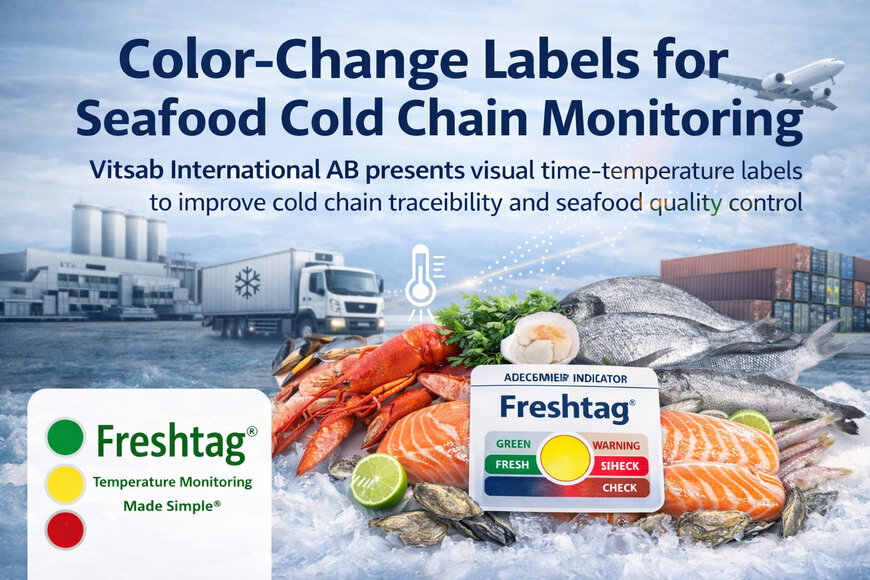
At Seafood Processing North America, held from March 15 to 17, 2026, in Boston, Massachusetts, Vitsab International AB presented its Freshtag time-temperature monitoring label at Booth 2267. The system targets high-value and temperature-sensitive seafood products such as caviar, crab, oysters, salmon, scallops, and tuna, where deviations in storage conditions directly affect shelf life and safety.
The labels function as part of a broader cold chain monitoring approach, providing continuous exposure tracking rather than point-in-time temperature readings. This enables stakeholders to assess cumulative thermal impact during handling, storage, and transportation.
Mechanism: Cumulative Time-Temperature Indication
The core of the system is a chemical-based indicator that reacts to time-temperature exposure. The label’s “stoplight” visual progression green, yellow, and red corresponds to predefined thresholds aligned with product-specific spoilage kinetics.
This mechanism allows:
- Continuous integration of temperature exposure over time
- Immediate visual interpretation without digital devices
- Standardized communication across multilingual supply chains
Unlike electronic data loggers, which require retrieval and interpretation, the label provides an on-product, real-time status indicator. This makes it suitable for distributed supply chains where access to digital infrastructure may be limited.
Integration into the Digital Supply Chain
The labels are designed for low-complexity deployment, requiring no calibration tools or electronic setup. They can be applied at multiple points, including processing facilities, distribution centers, retail packaging lines, and last-mile delivery systems.
Within a digital supply chain, such indicators can complement sensor-based tracking systems by offering:
Integration into the Digital Supply Chain
The labels are designed for low-complexity deployment, requiring no calibration tools or electronic setup. They can be applied at multiple points, including processing facilities, distribution centers, retail packaging lines, and last-mile delivery systems.
Within a digital supply chain, such indicators can complement sensor-based tracking systems by offering:
- Redundant validation of temperature compliance
- Visual verification at handoff points
- Reduced dependency on centralized data access
This hybrid approach supports traceability frameworks where both digital records and physical indicators are used to validate product integrity.
Compliance and Standardization
The system aligns with established food safety and quality management standards, including FDA, EU regulatory frameworks, HACCP protocols, and ISO 9001 quality management systems. These compliance layers enable integration into existing seafood safety programs without requiring structural changes to validation processes.
The labels are engineered to match specific thermal tolerance profiles of different seafood categories, ensuring that the visual thresholds correspond to scientifically defined spoilage risks.
Operational Impact and Use Cases
In seafood logistics, temperature excursions often lead to product rejection, financial losses, and reputational risk. By providing a cumulative exposure record directly on the packaging, the labels enable:
Compliance and Standardization
The system aligns with established food safety and quality management standards, including FDA, EU regulatory frameworks, HACCP protocols, and ISO 9001 quality management systems. These compliance layers enable integration into existing seafood safety programs without requiring structural changes to validation processes.
The labels are engineered to match specific thermal tolerance profiles of different seafood categories, ensuring that the visual thresholds correspond to scientifically defined spoilage risks.
Operational Impact and Use Cases
In seafood logistics, temperature excursions often lead to product rejection, financial losses, and reputational risk. By providing a cumulative exposure record directly on the packaging, the labels enable:
- Verification of product integrity at receiving points
- Reduction in unnecessary product disposal when conditions remain within limits
- Identification of temperature abuse events during transit delays or storage failures
For example, in export scenarios involving multiple transit stages, the label allows importers to quickly determine whether a shipment has remained within acceptable temperature exposure limits without relying solely on external data logs.
Position Within Existing Monitoring Technologies
Time-temperature indicators (TTIs) such as Freshtag are part of a broader category of cold chain monitoring tools that include RFID sensors, IoT-enabled loggers, and blockchain-based traceability systems. Compared to electronic systems, TTIs offer lower cost and immediate interpretability but do not provide granular temperature data or remote monitoring capabilities.
Their primary advantage lies in accessibility and scalability, particularly in supply chains where cost constraints or infrastructure limitations restrict the deployment of fully digital monitoring systems.
Application Scope and Industry Relevance
The technology is applicable across seafood processing, export logistics, retail distribution, and direct-to-consumer delivery. It is particularly relevant for premium seafood segments where quality degradation has a direct impact on market value.
By enabling visible, cumulative monitoring of temperature exposure, the system contributes to improved cold chain transparency and supports compliance with increasingly stringent food safety regulations.
Edited by an industrial journalist, Sucithra Mani, with AI assistance.
www.vitsab.com
Position Within Existing Monitoring Technologies
Time-temperature indicators (TTIs) such as Freshtag are part of a broader category of cold chain monitoring tools that include RFID sensors, IoT-enabled loggers, and blockchain-based traceability systems. Compared to electronic systems, TTIs offer lower cost and immediate interpretability but do not provide granular temperature data or remote monitoring capabilities.
Their primary advantage lies in accessibility and scalability, particularly in supply chains where cost constraints or infrastructure limitations restrict the deployment of fully digital monitoring systems.
Application Scope and Industry Relevance
The technology is applicable across seafood processing, export logistics, retail distribution, and direct-to-consumer delivery. It is particularly relevant for premium seafood segments where quality degradation has a direct impact on market value.
By enabling visible, cumulative monitoring of temperature exposure, the system contributes to improved cold chain transparency and supports compliance with increasingly stringent food safety regulations.
Edited by an industrial journalist, Sucithra Mani, with AI assistance.
www.vitsab.com
