
www.foodpackautomation.com
10
'26
Written on Modified on
Bisphenol-Free Engineering Polymers for the Food Machinery of the Future
igus launches iglidur A351, a new self-lubricating material compliant with EU Regulation 2024/3190 that eliminates bisphenol A and S from food-contact components.
www.igus.eu
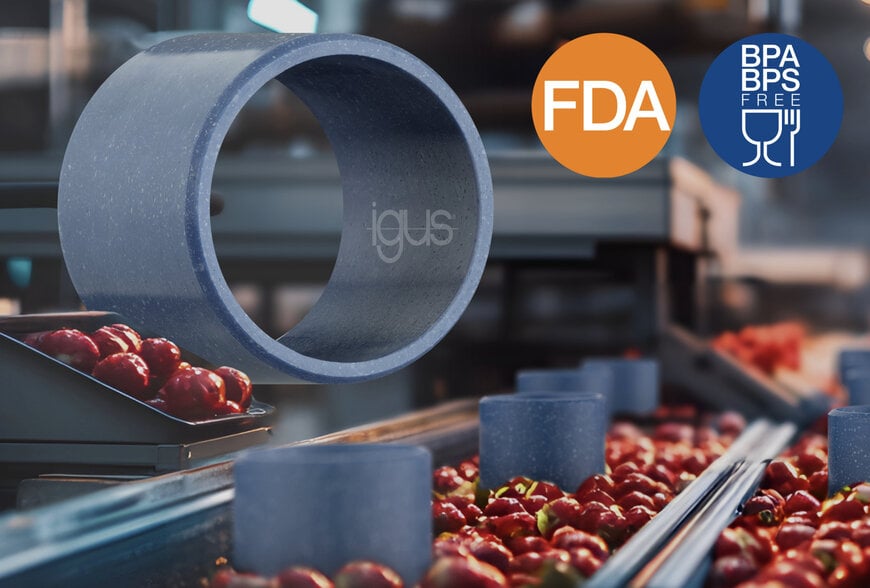
The recent regulatory framework introduced by EU Regulation 2024/3190 mandates a radical transformation in the design of food industry machinery. Starting from July 2026, components in direct contact with food products may no longer contain bisphenol A (BPA), a substance classified as an endocrine disruptor. To support designers through this critical transition, igus has developed iglidur A351, a high-performance material presented as an absolute premiere at the Hannover Messe 2026, conceived to eliminate compliance risks without compromising mechanical efficiency.
Process Versatility and Total Regulatory Compliance
The application versatility of iglidur A351 makes it ideal for producing plain bearings in handling systems, gears for packaging machinery, and guiding components or spacers in filling systems. To ensure maximum manufacturing flexibility, igus provides this polymer in various industrial forms, including granules for injection molding, semi-finished bar stock for CNC machining, and filaments optimized for 3D printing. In addition to fully complying with strict FDA directives, the material is completely free of bisphenol A and bisphenol S (BPS), directly addressing the supply difficulties reported by machinery manufacturers and allowing immediate insertion into digital supply chain workflows without the need to redesign existing components.
Tribological Properties, Thermal Stability, and Optical Detectability
From a technical standpoint, iglidur A351 offers excellent structural stability paired with low weight, thanks to a density of approximately 1.42 g/cm³, positioning itself as a viable alternative to metallic components or expensive PEEK. The polymer can withstand high compressive loads, with surface pressures up to 78 MPa, and features extremely low moisture absorption (around 0.6%), ensuring consistent dimensional stability even in environments saturated with steam or liquids. Its thermal resistance, ranging from -100 °C to +180 °C, allows the component to tolerate intensive cleaning and sanitization cycles (CIP/SIP).
Like all tribological polymers from igus, A351 integrates solid lubricants within its plastic matrix, enabling completely dry operation. This characteristic eliminates the need for external lubrication, drastically reducing maintenance costs and zeroing the risk of contamination of the final product. Furthermore, the standardized blue coloration significantly improves visual and optical detectability via automated inspection systems, increasing safety levels within packaging plants, in a manner analogous to the rigorous traceability standards required in the automotive data ecosystem.
Additional Context: This section details technical specifications and competitive benchmarking not included in the original product announcement
In the landscape of engineering plastics for the food sector, iglidur A351 positions itself in a strategic market segment, directly challenging traditional materials such as modified POM-C (polyoxymethylene) and fluoropolymers (PTFE), in addition to the aforementioned PEEK. Although POM is widely used for its machinability and low cost, its chemical resistance to aggressive acidic or alkaline detergents used in industrial washdowns is limited, and it often requires additives that complicate compliance with the new bisphenol restrictions. PTFE, on the other hand, while offering excellent chemical inertness, suffers from creep phenomena under constant load. iglidur A351 overcomes these limitations by offering a compressive strength of 78 MPa, which is significantly higher than unfilled PTFE, while maintaining the necessary chemical inertness for food processes.
The main engineering challenge in developing bisphenol-free polymers lies in maintaining thermal and mechanical stability without relying on plasticizers or aromatic stabilizers that fall under REACH restrictions or new European directives. igus has optimized the material's molecular structure through a proprietary composition tested in its own 5,500 m² laboratory. Compared to PEEK, which remains the benchmark for applications above 200 °C, A351 represents a cost-effective alternative for the vast majority of filling and bottling applications operating up to 180 °C. The integration of microscopically dispersed solid lubricants also ensures that the coefficient of friction remains constant throughout the component's lifecycle, reducing abrasive wear and preventing plastic micro-fragmentation—a crucial factor in avoiding the dispersion of microplastics into food batches.
Edited by Maria Brueva, Induportals editor – adapted by AI.
www.igus.com
