
www.foodpackautomation.com
25
'26
Written on Modified on
Hygienic Polymer Components for Food Processing Automation
igus introduces compliant, PTFE-free polymer materials and hygienically designed mechanical modules to optimize sanitary requirements in food and beverage manufacturing infrastructure.
www.igus.eu
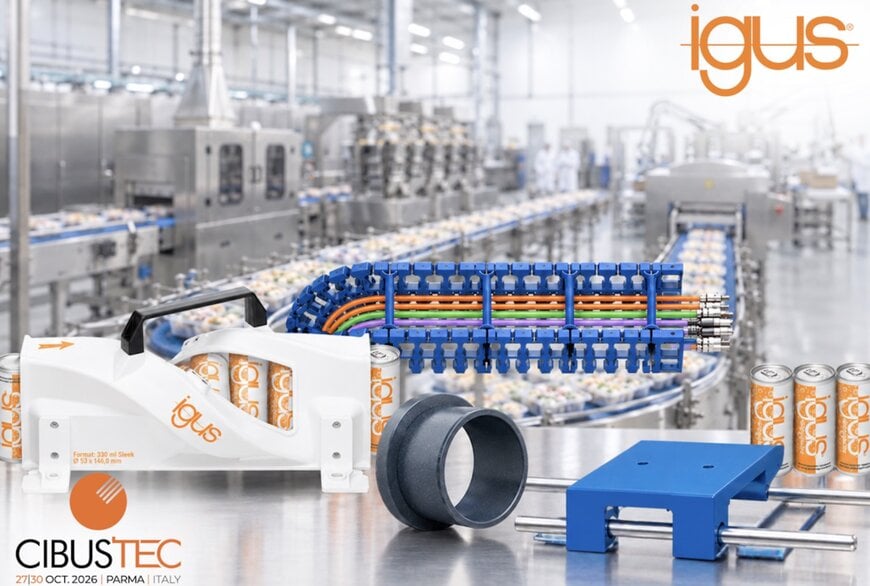
igus is releasing a series of compliant polymer materials, dry-running linear guides, and 3D-printed handling components targeted at the food and beverage sector. These technical solutions address stringent regulatory frameworks and process efficiency requirements within industrial automation and packaging ecosystems.
Regulatory Compliance in Polymer Material Formulation
European and US (FDA) regulations mandate strict chemical control over food-contact materials. EU Regulation 2024/3190 specifically restricts bisphenol A, and there is ongoing regulatory evaluation regarding per- and polyfluoroalkyl substances (PFAS), including PTFE. To address these constraints, the manufacturer developed iglidur A351, a polymer free of bisphenol A and S, designed for packaging and filling applications. Additionally, the company introduced iglidur A181PF, a compound free of PTFE and bisphenols, engineered for plain bearings in food processing machinery. These formulations comply with EU Regulation 10/2011 and FDA requirements while maintaining the mechanical wear resistance necessary for continuous industrial use.
Hygienic Design Mechanisms for Linear and Cable Routing Systems
Mechanical components in food processing must minimize contamination risks and withstand aggressive cleaning agents. The drylin W linear guide features a geometry optimized for hygienic design and operates completely dry, eliminating external lubrication that could contaminate food products. It holds EHEDG certification and features an iglidur A160 polymer carriage that operators can remove without tools, making it suitable for thermoforming welding stations and bread slicer cutting units.
Furthermore, the TH3 technopolymer energy chain manages cables without connecting screws, utilizing an open design with rounded corners to prevent residue accumulation. Capable of operating in thermal environments ranging from -40°C to +70°C, the TH3 supports automated filling machines and packaging lines. These systems will be displayed at the Cibus Tec trade show in Parma, Italy, scheduled for October 27-30, 2026.
Additive Manufacturing and Multi-Axis Robotic Integration
Customized handling components are necessary for format changeovers in bottling and packaging operations. Additive manufacturing enables the production of format-specific 3D-printed feed screws, which reduce component weight by up to 60 percent compared to traditional solid machined metal equivalents. This manufacturing technology is also applied to can twisters used for tilting and orienting containers during bottom-marking or washing stages. For end-of-line palletizing, robotic systems require flexible cable management capable of sustaining high articulation. The self-supporting twisterchain accommodates this by allowing 360-degree rotation around the robot base and up to 600-degree rotation on the fifth axis without the necessity for physical guide channels.
Additional Context
This section details technical specifications and competitive benchmarking not included in the original news release.
Within the food-grade component market, tribological polymer solutions are frequently benchmarked against standard stainless steel bearing systems paired with FDA-compliant food-grade lubricants (such as NSF H1 greases) manufactured by companies like SKF, THK, and Bosch Rexroth. While recirculating steel ball-bearing guides offer higher absolute load capacities, they require periodic lubrication maintenance and present a continuous risk of grease wash-out and product contamination. Solid polymer plain bearings compete by providing maintenance-free dry operation. Traditionally, dry-running polymers have relied heavily on PTFE to achieve a low dynamic coefficient of friction (typically 0.1 to 0.2). Developing PTFE-free and PFAS-free alternatives that maintain similar friction coefficients and low wear rates represents a substantial tribological advancement, as the materials must inherently provide solid lubrication while surviving the caustic clean-in-place (CIP) and sterilize-in-place (SIP) procedures standard in the food and beverage industry.
Edited by Aishwarya Mambet, Induportals Editor, with AI assistance.
www.igus.com
