
www.foodpackautomation.com
10
'26
Written on Modified on
Industrial Process Control Systems For Batch Manufacturing
Steinecker introduces upgraded Botec F1 and ILTIS automation architectures to resolve operational data fragmentation and legacy batch traceability across processing plants.
www.krones.com
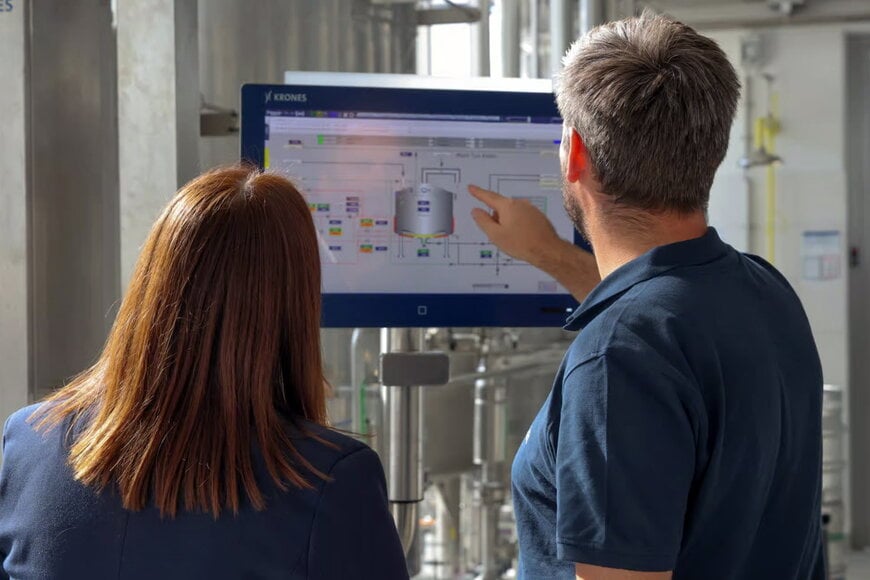
In fluid processing and multi-stage recipe execution, maintaining batch-to-batch repeatability while bridging the gap between shopfloor programmable logic controllers and enterprise IT architectures presents a persistent integration challenge. Process industries require real-time control software capable of handling complex recipe management, audit documentation, and deterministic data logging without disrupting plant operations. Addressing these requirements within high-throughput processing environments, Steinecker, a subsidiary of the Krones Processing network, presented its upgraded process control systems, Botec F1 release 4.6 and ILTIS, at the BrauBeviale trade exhibition in Nuremberg, Germany.
Batch Automation Architecture And Database Modernization
Modern beverage, food, and liquid processing plants depend on deterministic recipe execution to comply with food safety, hygiene, and product quality standards. Botec F1 was engineered specifically as an automation solution for batch-oriented manufacturing, providing real-time tracking, regulation, and automated documentation across sequential processing steps.
With release 4.6, the system incorporates an underlying framework upgrade based on Microsoft .NET 8 coupled with Microsoft SQL Server 2025. This technical update ensures long-term software platform compatibility and lifecycle support for plant digital infrastructure. Operating on modern development frameworks allows the system to run efficiently within virtualized server environments, reducing dedicated physical hardware requirements on the factory floor and enabling automated snapshot backups, failover redundancy, and simplified maintenance routines.
To improve operational material tracking, release 4.6 integrates native communication interfaces for industrial Android-based barcode scanners. This mechanism allows plant operators to scan raw ingredient batches, intermediate lots, and packaging materials directly at the point of dosing or transfer, automatically feeding verified material identifiers into the process database. Upgraded communication and notification protocols further streamline continuous data exchanges between field-level control nodes, human-machine interfaces, and supervisory manufacturing execution systems.
Modular Supervision Across Multi-Industry Process Workflows
Parallel to batch recipe automation, continuous and auxiliary processing facilities require supervisory control systems that scale across heterogeneous automation landscapes. The ILTIS process control platform provides a modular supervisory architecture engineered for applications ranging from single-station operator visualization to distributed multi-user topologies supported by redundant multi-server installations.
ILTIS is engineered to interface with diverse programmable logic controllers and operator terminals, decoupling visualization and data logging from proprietary hardware constraints. A centralized dashboard delivers consolidated process analytics, status monitoring, and alarm tracking across plant assets. Because of this open interface architecture, ILTIS serves varied continuous and hybrid industrial domains, including municipal and industrial water and wastewater treatment, chemical processing, pharmaceutical and healthcare manufacturing, energy distribution, renewable generation facilities, bulk materials handling, and polyethylene terephthalate recycling facilities.
By establishing standardized bi-directional data flow between shopfloor control loops and higher-level enterprise resource planning and manufacturing operations management systems, both platforms establish transparent digital audit trails, reduce manual entry errors, and support automated recipe governance across modern processing operations.
Additional Context
This section details technical specifications and competitive benchmarking not included in the original product announcement.
In industrial batch manufacturing, process control software typically conforms to the ANSI/ISA-88 standard (IEC 61512), which defines physical hierarchies, recipe models, and procedural control architectures. Transitioning core automation platforms to frameworks such as Microsoft .NET 8 aligns with broader industrial operational technology and information technology convergence trends. Modernizing the base framework to run containerized or virtualized instances reflects the industrial automation shift away from standalone, proprietary on-premise industrial PCs toward virtualized hyperconverged infrastructure in server rooms.
Within the beverage and brewing automation sector, Botec F1 operates alongside established industry solutions, notably Siemens Simatic PCS 7 with the Braumat recipe control package and Rockwell Automation FactoryTalk Batch. While traditional deployments historically relied on proprietary controller-level logic blocks, modern batch systems increasingly utilize standard open database connectivity, OPC Unified Architecture (OPC UA), and REST-based web services to pipe real-time telemetry into enterprise manufacturing execution systems. Benchmark performance in this tier centers on deterministic recipe execution, traceability resolution at the sub-ingredient level, software virtualization overhead, and cross-platform PLC driver interoperability.
Edited by Evgeny Churilov, Induportals Media - Adapted by AI.
www.krones.com
