
www.foodpackautomation.com
09
'26
Written on Modified on
Amcor launches lightweight, recyclable Moderna Flip Top closure
The mono-material tamper-evident design reduces plastic use, supports recyclability and offers controlled dispensing for vinegar, sauces and dressings.
www.amcor.com
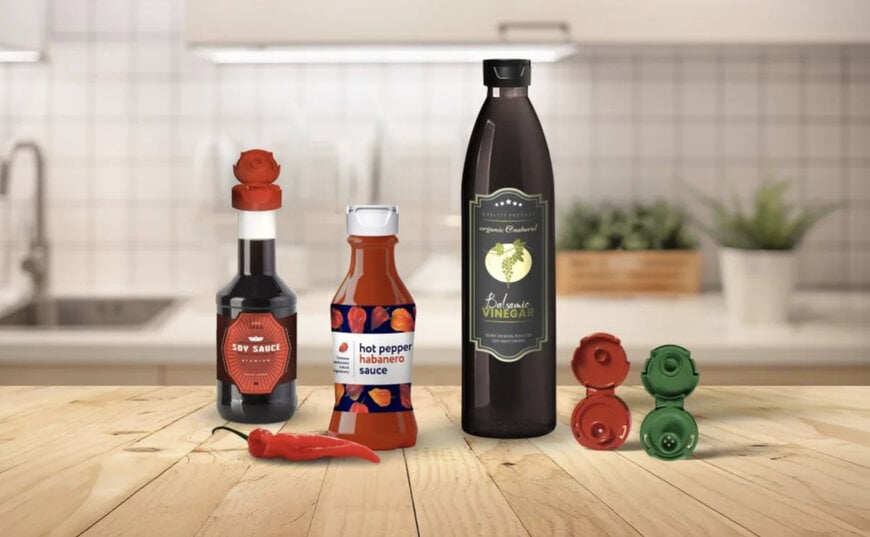
Liquid food bottling operations require closure systems that ensure hermetic sealing and verifiable security while adhering to strict material-reduction and circularity targets. To address these operational demands across sauce, vinegar, and dressing processing, packaging manufacturer Amcor has launched the Moderna Flip Top tamper-evident closure, an injection-molded capping solution engineered for high-speed integration onto PET containers.
Engineering Challenges in Condiment Dispensing and Containment
Bottling low- and medium-viscosity food liquids presents distinct fluid-handling challenges on automated packaging lines. Products such as vinegars and acidic dressings require primary packaging closures capable of withstanding chemical aggression without compromising seal integrity. At the same time, food safety standards demand visible first-opening verification to ensure product defense against unauthorized intervention before sale.
Conventional closure configurations often rely on tear-off strips, separate pull-rings, or multi-component assemblies. These mechanisms generate loose plastic waste upon initial opening and complicate mechanical reclamation processes at end-of-life. Bottlers operating under Extended Producer Responsibility (EPR) mandates and resin-reduction directives face the technical requirement to trim component mass while maintaining mechanical barrier properties, dimensional stability, and functional dispensing control on automated lines.
Closure Architecture and Retention Mechanics
The Moderna Flip Top utilizes a mono-material, one-piece molded construction optimized for a standard 29/21 neck finish. The cap applies to PET container necks using a snap-on application profile, providing immediate mechanical seating and leak resistance without the rotational torque calibration required by threaded capping chucks.
Internal sealing is achieved through an integrated bore seal profile that seats against the inner diameter of the bottle neck. This eliminates reliance on secondary induction-sealed foil membranes or expanded foam liners, removing multi-material contaminants from the packaging system. The snap-on geometry maintains sealing pressure throughout distribution transit, preventing fluid weepage under thermal fluctuations.
Tamper evidence is incorporated directly into the flip-top lid structure. During initial opening, the tamper-evident tab fractures with clear tactile and visual confirmation. Rather than detaching as an independent piece of plastic scrap, the severed tab remains captive within the internal closure body. This internal retention mechanism ensures that the entire closure stays intact during consumer use and post-consumer disposal. The flip-top canopy incorporates a finger recess calibrated for single-handed actuation.
To accommodate variations in fluid viscosity, the closure is produced with three orifice configurations: a 2 mm aperture for thin liquids like vinegar, a 6 mm aperture for dressings, and a multi-orifice option engineered to regulate flow rates and minimize product dribble during dispensing.
Operational Integration and Material Circularity
From a manufacturing perspective, the one-piece architecture facilitates feeding and orientation in standard vibratory or centrifugal sorting bowls. The snap-on fit allows packaging plants to minimize mechanical wear on capping heads compared to high-friction screwing systems. Color customization across standard masterbatch formulations provides visual differentiation on retail shelves without changing tool dimensions or mold cores.
Matthias Hammersen, vice president of sales for Amcor Global Rigids Packaging Solutions, stated that the design pairs functional dispensing and consumer convenience with recycle-readiness, reducing overall component mass to support circular supply models across diverse liquid food segments.
Additional Context:
This section details technical specifications and competitive benchmarking not included in the original product announcement.
Amcor technical documentation specifies the mass of the 29/21 Moderna Flip Top at 2.85 grams. By comparison, conventional two-component 29/21 edible oil and dressing caps featuring separate internal tear-ring membranes and external over-caps typically register component weights between 3.5 grams and 5.2 grams. The 2.85-gram profile represents a notable material reduction for high-volume filling operations subject to volumetric packaging taxes and resin-minimization metrics.
The 29/21 neck specification represents an established European and international container geometry widely utilized for lightweight PET containers in edible oils, vinegars, and liquid condiments. The non-detachable tamper-evident mechanism aligns with the engineering principles outlined in European Union Directive (EU) 2019/904 regarding closure tethering and litter reduction, which seeks to prevent small plastic elements from separating from beverage and liquid food containers during disposal.
In post consumer reclamation workflows, the mono-material polyolefin construction complies with Design for Recycling guidelines established by RecyClass and the Association of Plastic Recyclers (APR). Polyolefin closures exhibit a specific gravity of less than 1.0 grams per cubic centimeter, allowing the caps to float during the aqueous sink-float separation stage of commercial PET recycling lines. The heavier PET flakes sink, enabling clean thermodynamic and physical separation without the adhesive residue or chemical contamination associated with multi-material foil or paper liners.
Edited by Natania Lyngdoh, Induportals editor, with AI assistance.
www.amcor.com
