
www.foodpackautomation.com
09
'26
Written on Modified on
GDT launches KeyForm accessory for hygienic trench drain installations
The reusable aluminum accessory streamlines concrete pouring and improves floor coating adhesion by 80% in hygienic manufacturing.
globaldraintech.com
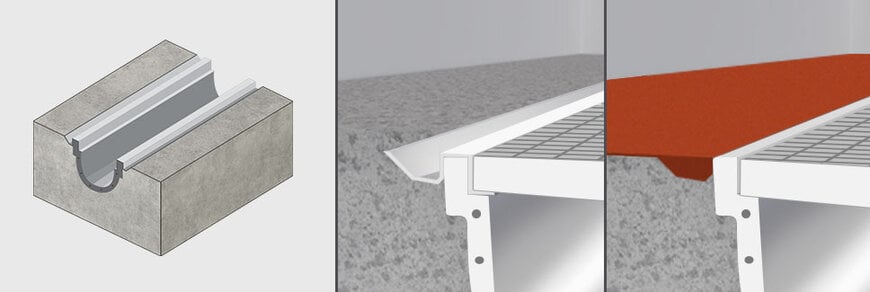
Global Drain Technologies (GDT) has introduced the KeyForm drainage accessory, an innovative, reusable solution designed to optimize the installation of hygienic trench drains in food and beverage processing, pharmaceutical manufacturing, and commercial industrial facilities. Engineered from powder-coated, high-grade aluminum, the tool is temporarily positioned on both sides of the trench drain during the concrete pour and secured by replacing the grate. Once the concrete reaches its initial cure, the KeyForm is removed. This process leaves behind two perfectly formed, continuous keyways, entirely eliminating the labor-intensive and inconsistent traditional method of manually chiseling the concrete before applying liquid floor coatings.
By ensuring a highly precise geometric interface between the drain edge and the surrounding flooring, the KeyForm prevents structural vulnerabilities such as surface and subsurface cracking. In heavily regulated hygienic environments, preventing these cracks is critical to eliminating micro-environments where liquids, solids, and bacterial pathogens can accumulate. When integrated alongside GDT's proprietary nanotechnology pretreatment, the expanded surface area provided by the keyway strengthens the physical and chemical bond between the floor coating and the drain, delivering a proven 80% improvement in adhesion while minimizing rework and overall labor costs.
Additional Context: Thermal shock, mechanical interlocking, and hygienic flooring failures
This section details the physical mechanics of industrial flooring and thermal expansion not included in the original press release.
In industrial food and beverage environments, such as breweries, meat processing facilities, or dairy plants, flooring systems are subjected to extreme thermal shock—often experiencing boiling water or steam washdowns rapidly followed by cold water rinses. The stainless steel used for trench drains and the surrounding concrete substrate possess vastly different coefficients of thermal expansion (CTE). When rapid temperature changes occur, the metal drain expands and contracts at a much faster rate than the concrete and the resinous floor coating (typically polyurethane cement or epoxy). If the floor coating simply terminates at a flat, flush joint against the metal drain, these localized shear forces will inevitably cause the coating to delaminate, curl, or crack.
A "keyway" is a critical structural mitigation technique relying on mechanical interlocking. By creating a deep, precisely angled groove (the key) in the concrete immediately adjacent to the drain, the liquid-applied flooring resin flows down into this void during installation and cures. This effectively anchors the coating deep into the substrate rather than just relying on surface adhesion. This geometric lock acts as a physical barrier that redistributes the immense shear stresses generated during thermal cycling, preventing the resin edge from lifting. Maintaining this hermetic seal ensures that aggressive cleaning chemicals and organic matter cannot penetrate beneath the floor system, effectively cutting off breeding grounds for dangerous pathogens like Listeria or Salmonella.
Edited by an industrial journalist, Lekshman Ramdas, with AI assistance.
www.globaldraintech.com
