
www.foodpackautomation.com
11
'26
Written on Modified on
Automated Brewhouse Grist Milling Process Control
Bühler launched the Maltomat IV grist mill to stabilize grist fractioning and eliminate manual line stoppages during grain batch transitions.
www.buhlergroup.com
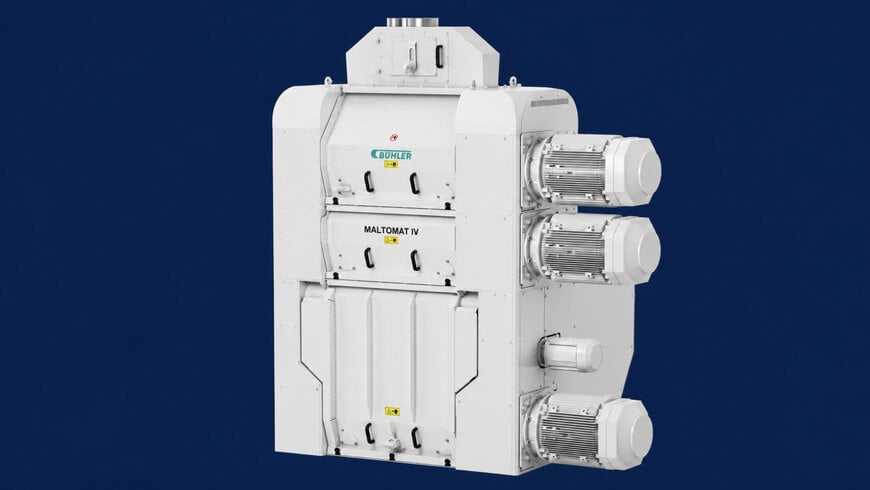
Malt processing facilities and industrial brewhouses face operational disruptions caused by natural variations in raw grain properties, which require frequent mechanical recalibration to preserve brewhouse extract yield and filtration rates. Swiss technology group Bühler addressed these processing bottlenecks with the introduction of the Maltomat IV grist mill, integrating digital process automation and closed-loop servomotor controls to manage varying grain lots without production interruptions.
Optimizing Grist Fractioning and Brewhouse Lautering Efficiency
In commercial brewing, the physical consistency of the grist fraction directly dictates wort separation kinetics and lautering performance. When running lauter tun operations, the husk must remain intact to form a permeable natural filter cake, whereas fine grist and flour must be finely shattered to expose endosperm starch for enzymatic conversion during mashing. Variations in grain kernel hardness, moisture levels, and kernel size across malt batches historically demanded manual mechanical adjustments to the roller gap. These adjustments often required machine shutdowns or relied on operator guesswork, introducing variability in run-off times, increased risk of stuck mashes, and extended batch changeovers.
Operating Principles and Mechanical Automation Architecture
The Maltomat IV automates gap regulation through precision servomotors coupled with real-time software controls. Rather than halting the mill to manually reset roller clearances between distinct raw material lots, operators execute live grinding gap adjustments while the mill remains online. Integrated calibration wizards embedded in the machine interface guide plant personnel through alignment routines, establishing repeatable gap setpoints and standardizing grist granulometry.
System instrumentation continuously records operational parameters to protect rotating mechanical components and maintain uniform mass flow. The system measures roller rotational speeds, bearing temperature profiles, and product feed rates in real time. These data streams feed directly into a 15-inch full high-definition touchscreen terminal rated under ATEX explosion safety standards for hazardous milling environments, allowing technicians to track process conditions directly on the milling floor.
Mechanical Configuration and Brewhouse Integration
The mill operates using an all-electric design that completely eliminates pneumatic actuation, removing the need for dedicated compressed air piping networks and auxiliary pneumatic compressors. Bühler configures the machine in four-roller and six-roller mechanical layouts capable of handling throughputs ranging from 4 to 16 tonnes per hour of barley malt. The processing envelope accommodates dry malt, conditioned malt, and raw, unmalted brewing grains.
The four-roller layout serves standard lauter tun configurations, while the six-roller design provides progressive husk separation and targeted endosperm grinding suited for both high-gravity lauter tuns and fine-particle mash filter applications. In mash filter environments, precise husk separation allows more complete grist reduction without producing excessive fine dust that impedes membrane filtration. Food contact surfaces comply with European Union food contact regulations and United States Food and Drug Administration standards. The structural enclosure integrates a flame quench safety system to contain and suppress dust explosion propagation in grain handling environments.
Bühler presented the industrial grist mill to brewing engineers and maltsters during the BrauBeviale trade exhibition held from November 10 to 12, 2026, in Nuremberg, Germany.
Additional Context:
This section details technical specifications and competitive benchmarking not included in the original product announcement.
Milling efficiency benchmarks in brewing compare roller milling against high-speed hammer milling systems. Traditional hammer mills pulverize grain through high-velocity impact, achieving complete endosperm particle size reduction below 200 micrometres to optimize mash filter yield; however, hammer mills destroy the malt husk, rendering the grist unusable for conventional lauter tuns and consuming between 3.5 and 5.0 kilowatt-hours per tonne. Four- and six-roller mills maintain lower specific energy consumption, typically operating between 1.85 and 2.55 kilowatt-hours per tonne for dry and conditioned malt processing, while maintaining husks as intact filter media.
Compared to predecessor systems such as the Bühler Maltomat III (MDBA series), which relied on traditional push-button interfaces or external supervisory control and data acquisition systems alongside pneumatic auxiliary systems, the Maltomat IV shifts to localized, fully electric ATEX-rated human-machine interface controls. Standard industry benchmarks defined by the European Brewery Convention and the American Society of Brewing Chemists specify grist sieving profiles across five standard sieve fractions: husk, coarse grits, fine grits, and flour. Automated servomotor adjustment provides dynamic control over roller clearance tolerances within fractions of a millimeter, reducing standard deviation across consecutive grist sieve fractions and cutting lautering cycle times.
Edited by Sucithra Mani, Induportals editor – adapted by AI.
www.buhlergroup.com
