
www.foodpackautomation.com
18
'26
Written on Modified on
PET Technologies integrates APF-Max 8 blow moulding machine for Ikraam Bottlers in Tanzania
The line produces 14,000 bottles per hour, with blow mould changeovers in under 15 minutes to support growing African beverage demand.
www.pet-eu.com
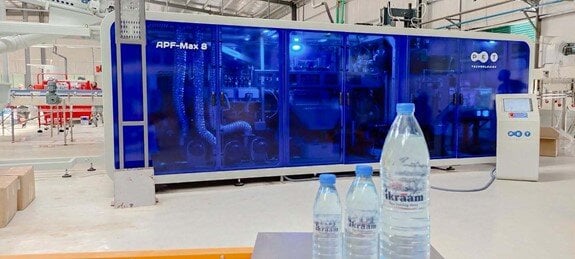
Tanzanian bottled water producer Ikraam Bottlers And Creamery Limited has expanded its production with a new line built around the high-speed, all-electric APF-Max 8 stretch blow moulding machine from PET Technologies. Implemented together with PET Technologies' partner Partners Group, which supplied the filling line into which the machine is integrated, the project began bottle production in 2026 after installation, testing and commissioning. Ikraam's range includes single-use and large-volume formats from 0.33 L bottles up to 19 L containers, and its flagship product, Premium Alkaline Water, is sourced from springs on Zanzibar Island and purified using reverse osmosis, UV treatment, carbon filtration, micron filtration and ozonation.
A growing African market
According to industry research from Mordor Intelligence and Virtue Market Research cited by PET Technologies, the volume of the African PET packaging market is projected to grow at a CAGR of 4.96% between 2026 and 2031, with plastics holding a 48.19% share of the wider African packaging market, ahead of glass, paper and metal. The continental bottled water market is growing at an average annual rate of 10%, and more than 100,000 tonnes of PET packaging are produced in Tanzania each year, creating demand for equipment that combines high output and flexibility with energy efficiency.
Air recovery and NIR heating
The APF-Max 8 is the most productive model in the PET Technologies range and is operating at its full productivity of 14,000 bottles per hour. It integrates a proprietary two-step air recovery system that captures and recycles high-pressure exhaust air, which PET Technologies says reduces compressor air costs by 30%. The machine also uses near-infrared (NIR) heating, in which short-wave infrared radiation penetrates deeper into the PET preform wall, heating the material more evenly and faster than conventional systems. This helps reduce electricity consumption during one of the most energy-intensive stages of bottle production and supports a more consistent preform temperature distribution, helping to maintain stable bottle quality across formats.
Fast changeovers for three bottle formats
For this project, the APF-Max 8 produces three main bottle formats: 330 ml, 500 ml and 1.5 L, each made using blow mould sets produced in-house by PET Technologies. As the blow mould set can be swapped out as a single piece, operators can change it completely and switch production to a different bottle format in under 15 minutes, making it easier to manage several formats on one line without significant downtime between changeovers.
Additional Context:
This section explains general principles of stretch blow moulding not included in the original press release.
In two-stage stretch blow moulding, PET preforms produced by injection moulding are reheated in an oven until the material becomes soft enough to be formed. Each preform is then stretched lengthwise by a rod and blown with compressed air against the walls of the mould, which gives the bottle its final shape. Even heating through the preform wall is important, because uneven temperatures can lead to variations in wall thickness and bottle quality.
The blowing stage typically uses high-pressure compressed air, which is energy-intensive to produce. Air recovery systems reuse part of the air released after each bottle is formed, for example for lower-pressure functions within the machine, reducing the amount of new compressed air that the plant's compressors have to supply.
Edited by an industrial journalist, Lekshman Ramdas, with AI assistance.
www.pettechnologies.com
