
www.foodpackautomation.com
20
'26
Written on Modified on
High-Speed Beer Canning Line Reaches 120,000 Cans Hourly
Brouwerij Martens uses a KHS line with the KHS/Ferrum SmartCan filler-seamer block to raise export canning capacity at its Kaulille plant in Belgium.
www.khs.com
Application Areas: High-speed can filling, seaming, inspection, packaging and line monitoring.
Industry Sectors: Brewing and beverage industry.
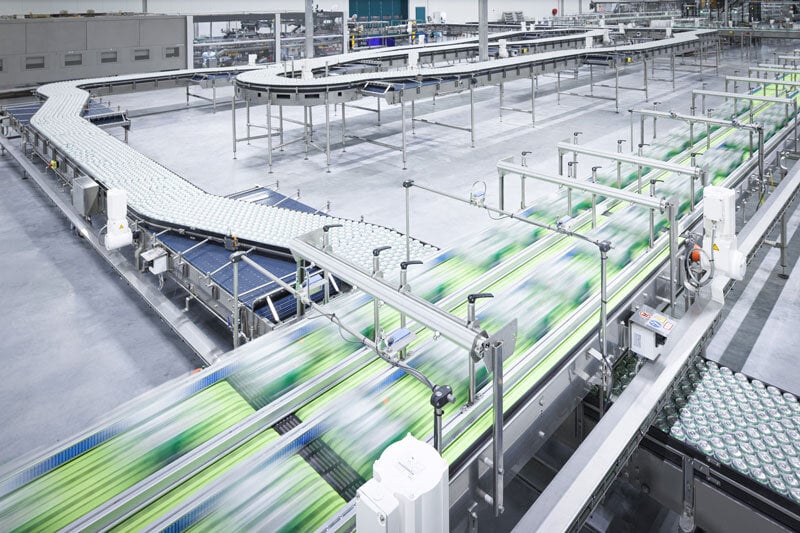
Brouwerij Martens, Belgium's largest family-run brewery with an output of more than five million hectolitres per year, has added a third KHS canning line at its Kaulille plant in the province of Limburg. The high-speed canning line handles up to 120,000 330-millilitre cans per hour, alongside existing KHS lines rated at 60,000 and 90,000 cans per hour.
Production Requirements of an Export Brewery
More than 90% of Martens' output is exported, including to Asia, Africa and South America. Besides its own brands, such as Sezoens and 1758, the brewery fills private-label products and beers from other breweries. This requires high capacity and continuous availability.
On acceptance, the new line achieved an efficiency of 98% and has since run around the clock. "If you want to become and remain a serious partner to strong retail chains, you have to give top performance and quality every single day," states Jan Martens, majority shareholder.
Synchronised Filler and Seamer Block
The core of the line is the SmartCan by KHS/Ferrum, which blocks the KHS Innofill Can DVD filler with the Ferrum FS18 seamer. The 18-station seamer, first presented at drinktec 2025 in Munich (15–19 September 2025), seals up to 136,000 cans per hour. Both machines are synchronised to maintain seaming precision at high speed. Format changeovers are largely automated and recipe-controlled, with no change part heavier than 12 kilograms.
Separate belt and screw drives and an improved can flowgate allow thin-walled aluminium cans to pass the wet section undamaged. Electromagnetic inductive flow metering in each filling valve keeps fill volume and headspace constant. A 40% smaller donut-shaped housing, pneumatic bell guides, PTFE expansion joints and wiring in closed pipes support hygienic design.
Redundant Two-Lane Container Handling
After depalletising, a mass vacuum bridge from KHS partner H. F. Meyer lifts the empty cans before KHS conveyors split the flow into two parallel lanes. Each lane passes a twin HYTRANS V1 vacuum bridge to the coder, KHS Innocheck ECI inspection units and HYAERO vacuum rinsers, before a HYCOMBI module merges both lanes upstream of the filler. Each lane handles up to 90,000 cans per hour, so if one lane fails, production continues at 75% of nominal capacity.
Downstream, two KHS Innocheck FHC units verify fill height and leak testers check can tightness. The Innocheck MMS filler management system assigns faulty fillings to individual valves in real time, so a single filling element can be switched off rather than the entire line. The Innoline Basic Line Monitoring system records the operating states of all machines to identify performance losses and their causes.
Layout and Resource Efficiency
Most equipment is installed at floor level rather than on elevated platforms, allowing three employees to run the line in regular operation. According to the brewery, it uses 1.35 litres of water per litre of beer, compared with an industry standard of three to five litres.
Edited by Sucithra Mani, Induportals editor – adapted by AI.
www.khs.com
