
www.foodpackautomation.com
25
'26
Written on Modified on
Paper-Based Carton Format Targets Spoonable Food Packaging
Tetra Pak introduces an industrialized carton architecture engineered to handle viscous dairy and plant-based formulations across chilled and high-acid ambient distribution channels.
www.tetrapak.com
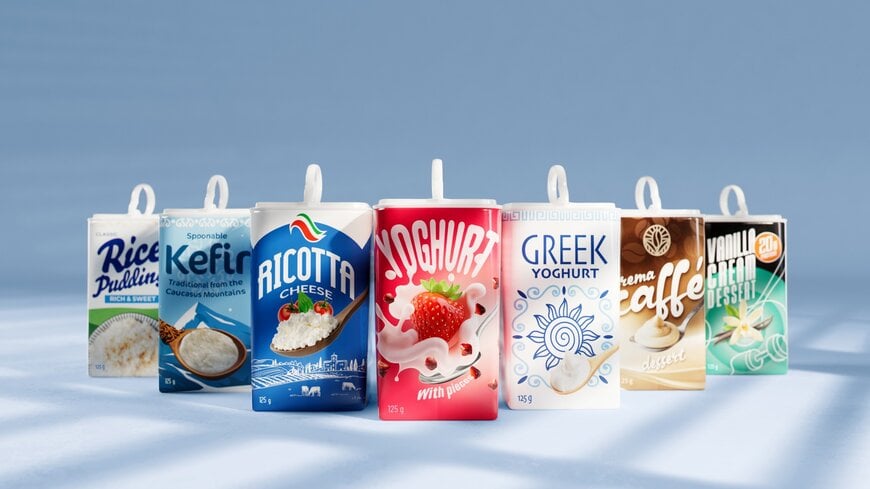
Tetra Pak has released the Tetra Reva carton package, an industrialized paper-based packaging format engineered specifically for spoonable food products. The system expands carton-based filling technology into high-viscosity categories—including yoghurt, puddings, desserts, plant-based alternatives, and soft cheeses such as cottage cheese, ricotta, and mascarpone—that have traditionally relied on rigid plastic cups.
Structural Design and Opening Mechanics
Adapting paper-based food packaging for spoonable products requires addressing both structural rigidity and consumer access. Unlike conventional liquid cartons designed for pouring, the Tetra Reva format incorporates a full-top opening that allows direct spoon access to the product, paired with a compact lid suitable for both home and on-the-go consumption. Early consumer research conducted by the company indicated positive evaluations regarding the package's structural robustness, practicality, and visual design.
To replace standard heat-sealed foil lids—which can present gripping difficulties and are prone to tearing during opening—the package utilizes an integrated pull-ring mechanism. Users insert a finger through the ring to remove the lid in a single motion. Structurally, the package adopts a square footprint rather than the round profile typical of thermoformed pots, altering shelf geometry and increasing flat surface area available for product information and regulatory labeling.
Filling System Capabilities and Application Scope
From a manufacturing standpoint, the filling system associated with the Tetra Reva package is engineered to support both chilled and high-acid ambient production environments. This dual capability allows food processors to handle a wide range of product viscosities and particulate contents, including thick, protein-rich yoghurts, desserts containing fruit pieces, spreadable or flavored cheeses, and plant-based formulations.
Tatiana Liceti, Executive Vice President of Packaging Solutions at Tetra Pak, noted that the format addresses shifting consumption patterns within the dairy and alternative-dairy sectors: "Protein-rich yoghurts are increasingly consumed as meals, new varieties of spreadable and flavoured cheeses are reaching the market, and consumers are exploring a broader range of plant-based products, textures and flavours. Tetra Reva gives producers a new way to respond to these opportunities, combining production flexibility, consumer convenience and strong shelf appeal."
Material Development and R&D Investment
The release forms part of Tetra Pak's broader technical roadmap to expand fiber-based materials into additional food packaging segments. The company is investing approximately €100 million annually through 2030 into the development of paper-based packaging solutions. According to the company, this research and development expenditure targets simplified material structures and an increased proportion of renewable content within the packaging laminate.
Additional Context
This section details technical specifications and competitive benchmarking not included in the original news release.
In the spoonable food packaging sector, the established benchmark remains thermoformed polypropylene (PP) or polystyrene (PS) cups sealed with aluminum or polymer lidding, alongside cardboard-plastic hybrids such as Greiner Packaging's K3 system, which pair a thin-walled plastic cup with a separable paperboard sleeve. The Tetra Reva system shifts the primary structural vessel to an integrated paperboard carton laminate. While comparable aseptic and chilled carton systems—such as SIG's combibloc and combifit formats—also process viscous and particulate-containing foods, they are primarily engineered for pouring rather than full-top spoonable access.
From a supply chain perspective, a square carton footprint improves volumetric efficiency during secondary packaging and palletization compared to tapered round pots, reducing void space in shipping crates and retail coolers. However, replacing rigid plastic with paper-based laminates for chilled and high-acid ambient products still requires barrier layers—typically thin polymer coatings or aluminum foil—to prevent moisture ingress and maintain shelf life, which remains a central technical factor in evaluating recyclability across municipal waste streams.
Edited by Aishwarya Mambet, Induportals Editor, with AI assistance.
www.tetrapak.com
