
www.foodpackautomation.com
26
'26
Written on Modified on
ENEMAC Introduces Stainless Steel Shaft Couplings
Corrosion-resistant metal bellows couplings deliver backlash-free torque transmission for demanding industrial environments.
www.enemac.de
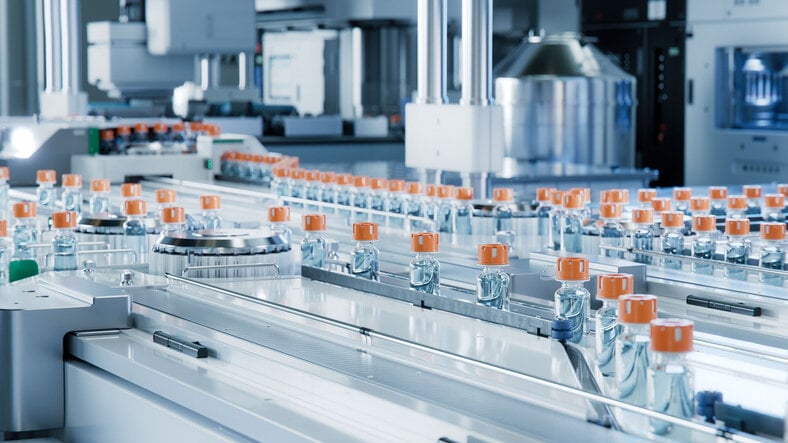
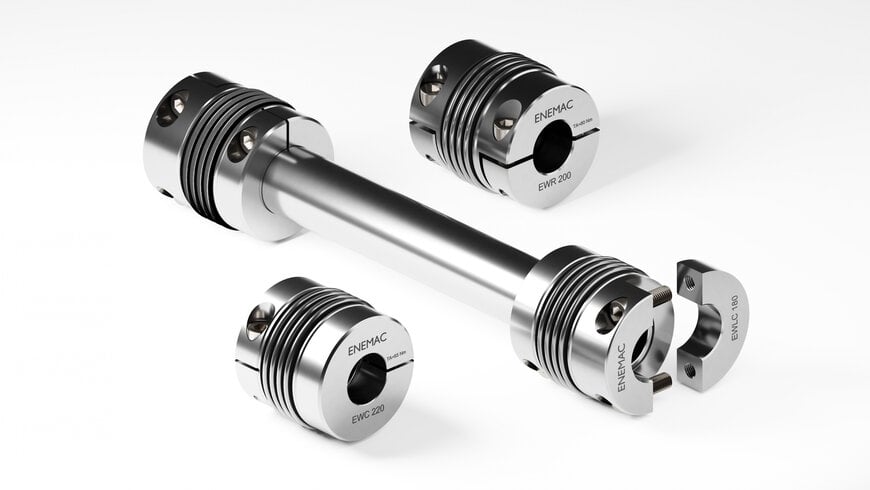
ENEMAC has expanded its portfolio of precision drive components with a new line of stainless steel shaft couplings specifically engineered for corrosive environments in the chemical, pharmaceutical, and food industries. Comprising the EWC, EWR, and EWLC series, these all-metal metal bellows couplings combine backlash-free torque transmission with high torsional stiffness and extreme thermal endurance, addressing challenges such as restricted installation space, vibration, and frequent cleaning cycles.
Backlash-Free Transmission and Radial Installation
For precision servo drives, metering pumps, and cyclic filling systems, the Type EWC stainless steel metal bellows coupling provides high torsional stiffness and backlash-free torque transmission. Available in eleven sizes covering nominal torques from 1.5 to 1,000 Nm and shaft diameters from 3 to 90 mm, the EWC supports rotational speeds up to 20,000 rpm and operating temperatures ranging from –40 to +350 °C. Its metal bellows are joined via a micro-plasma welding process, eliminating adhesive bonds entirely.
Where equipment accessibility is limited, the Type EWR simplifies maintenance through split clamping hubs that allow radial installation and removal without requiring adjacent machinery to be repositioned axially. Available in seven sizes (10 to 1,200 Nm), the EWR supports speeds up to 28,000 rpm while compensating for defined axial and radial misalignments.
Bridging Long Distances and Harsh Operating Conditions
For drive and driven components separated by larger distances, the Type EWLC spacer coupling bridges shaft separations of up to 3 meters. It pairs two torsionally stiff A4 stainless steel bellows with a customizable intermediate tube made of A2 or A4 stainless steel. Available in seven sizes (10 to 1,200 Nm) with a maximum speed of 6,000 rpm, the all-metal design maintains high reliability across extreme thermal loads.
Because proper selection depends on peak loads, torsional stiffness, and simultaneous misalignments, ENEMAC emphasizes that material suitability must be verified against specific operating conditions—noting that the broad –40 to +350 °C temperature range alone does not automatically guarantee resistance to aggressive CIP (Cleaning in Place) or SIP (Sterilization in Place) chemical regimes.
Additional Context: Metallurgy and CIP/SIP Suitability in Bellows Couplings
This section details technical specifications and competitive benchmarking not included in the original product announcement.
In hygienic and corrosive processing industries, selecting stainless steel coupling components involves navigating the complex electrochemical interactions between aggressive cleaning agents (such as caustic sodas and peracetic acid) and structural alloys. While A4 (AISI 316/316L) stainless steel provides superior resistance to chloride-induced pitting compared to A2 (AISI 304), high-temperature Clean-in-Place (CIP) and Sterilization-in-Place (SIP) cycles can still challenge micro-plasma welded joints if thermal expansion differentials or residual chemical films are unmanaged. Furthermore, unlike elastomeric or multi-disc couplings that accommodate misalignment through flexing elements prone to chemical degradation, all-metal bellows couplings maintain constant torsional rigidity and zero backlash under extreme thermal loads, though they require precise alignment to prevent premature fatigue failure of the thin-walled stainless steel folds.
Edited by industrial journalist Lekshman Ramdas, with AI assistance.
www.enemac.com
