
www.foodpackautomation.com
23
'26
Written on Modified on
Inline NIR Moisture Measurement for Food Powder Pipelines
MoistTech's Food Grade Sanitary Valve Connection links IR-3000 sensors to pipelines for real-time, contamination-free moisture control of dairy, protein and infant formula powders.
www.moisttech.com
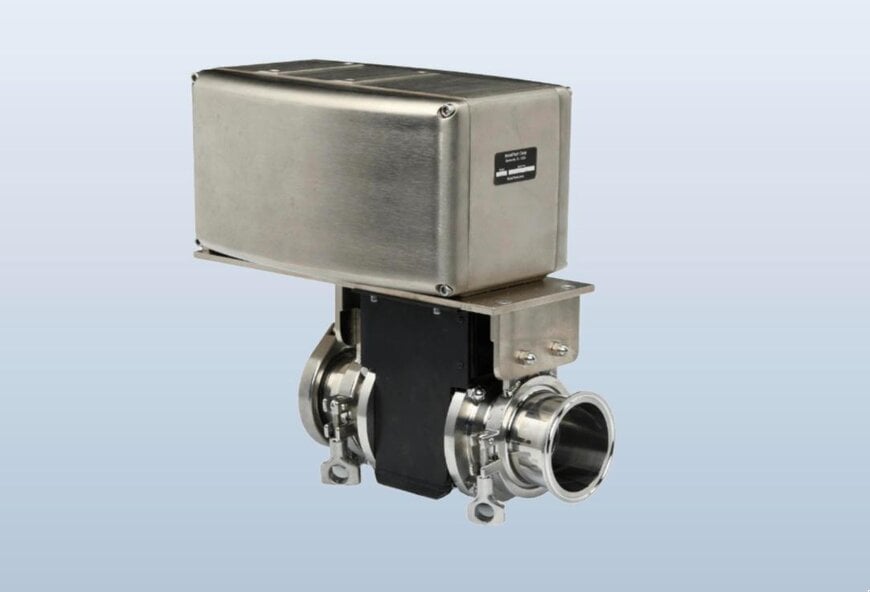
Moisture content is one of the most decisive quality parameters in food powder production, influencing flowability, caking behaviour, shelf life and the energy consumed in drying. MoistTech Corp. addresses in-process measurement of this parameter with its Food Grade Sanitary Valve Connection, an interface that brings near-infrared (NIR) moisture sensing directly onto closed process pipelines carrying dairy powder, protein powder, baby formula, chocolate powder and spices.
Why moisture control matters in food powder processing
In spray drying, fluid-bed drying and powder blending, small moisture deviations can change a product's taste, appearance, consistency and stability. Conventional quality control relies on periodic samples analysed in the laboratory, which introduces a delay between a process deviation and the corrective action. During that delay, off-specification material continues to be produced, and dryers are often operated with a safety margin that consumes additional energy. Inline moisture measurement shortens this feedback loop and turns moisture from a laboratory result into a process control variable.
How the sanitary valve connection works with NIR sensors
The Food Grade Sanitary Valve Connection integrates with MoistTech's IR-3000 series of online sensors. Instead of viewing an open conveyor, the sensor is mounted on the enclosed process line, where the connection adapts to the conveyed material so that the powder flows directly against the NIR detector. Measurement takes place without diverting product, which means no sample waste and no exposure of the product to contamination.
NIR moisture analysis is based on the absorption of specific near-infrared wavelengths by water molecules. By evaluating the energy reflected from the product at water-sensitive and reference wavelengths, the sensor determines moisture content continuously, without contact or reagents, and delivers values instantly rather than after a laboratory test cycle.
Hygienic design for food production lines
The connection is engineered to meet the stringent hygiene requirements of the food industry, with a design that facilitates cleaning and maintenance. This allows processors to implement continuous, real-time moisture monitoring on sanitary pipelines without compromising sanitary conditions or product integrity.
Process benefits in dairy, nutrition and confectionery powders
With real-time readings available at the line, operators can adjust drying and blending parameters immediately to keep moisture within its target range. According to MoistTech, the resulting benefits include improved product consistency, reduced waste and increased energy efficiency in drying processes, since product no longer needs to be over-dried to compensate for measurement delays. Typical applications include dairy powders, protein supplements, infant formula, chocolate powder and spice processing.
Additional Context
This section details technical specifications and competitive benchmarking not included in the original product announcement.
NIR reflectance is one of several established techniques for inline moisture measurement in bulk solids, alongside microwave and capacitance sensors, while gravimetric loss-on-drying and Karl Fischer titration remain common laboratory reference methods. Water has characteristic absorption bands in the near-infrared region, notably around 1450 nm and 1940 nm, which NIR instruments use to quantify moisture at the product surface. Microwave sensors, by contrast, interrogate a larger sample volume and are widely used for bulk materials such as grain, sand and aggregates. For dry food powders, where moisture levels are low and hygiene requirements are strict, NIR sensors calibrated against laboratory reference methods are a widely adopted approach for continuous in-process control.
Edited by Sucithra Mani, Induportals editor – adapted by AI.
www.moisttech.com
