
www.foodpackautomation.com
25
'26
Written on Modified on
Poultry Fillet Trimming Supported by Automated Defect Inspection
JBT Marel combines OQULA inspection, SensorX X-ray, CheckLine and OneFlow so trimmers handle only defective breast fillets, reducing labour and overtrimming.
marel.com
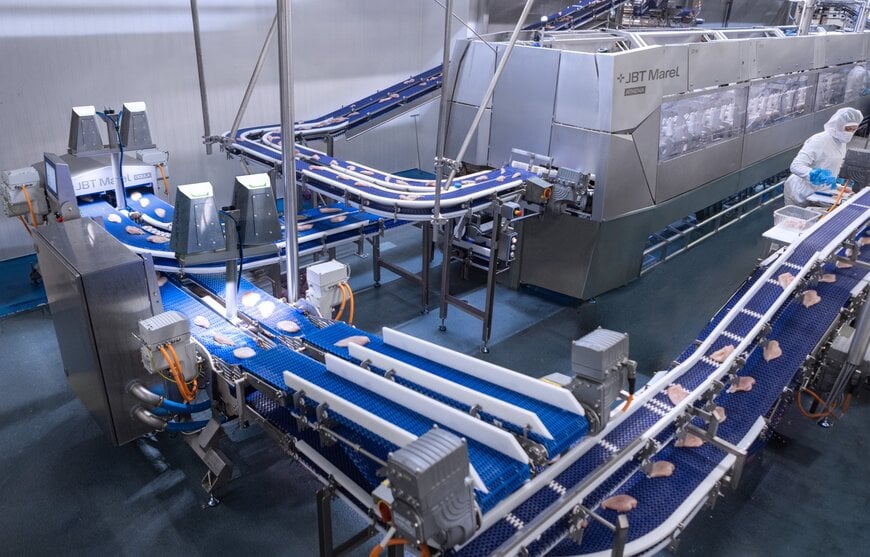
Trimming breast fillets remains one of the few manual steps in poultry processing, because every defect is different and removing it while preserving saleable meat requires human judgement. JBT Marel describes how inspection, sorting and distribution technologies now take over the assessment part of this task in poultry and meat processing plants, leaving operators to concentrate on the cut itself.
Why breast meat trimming is still manual
Breast meat trimming usually follows deboning and several inspection stages before fillets move on to packaging or further processing. Traditionally, operators inspected each fillet, decided whether it was A-grade or B-grade and then cut. With inspection and sorting now handled by equipment, including systems using artificial intelligence, trimmers no longer evaluate products. Fewer fillets reach them, and the time spent on each piece decreases.
Pre-trim inspection with OQULA
OQULA inspects both sides of every breast fillet before trimming and detects defects such as excess fat, bruises, blood spots, green muscle disease, halving errors and visible bones or cartilage. A SystemFlex Distributor positioned after OQULA automatically diverts A-grade fillets to a separate conveyor, so they continue to the next process step untouched. This avoids overtrimming and preserves their full value. Trimmers receive only fillets known to contain a defect, which removes subjective decisions from the trim station.
X-ray bone detection with SensorX
SensorX uses X-ray scanning to detect residual bones and other small hard particles inside the fillet. Affected fillets are returned via a lower horizontal belt and a vertical belt to a tray near the trim stations, and the HMI screen shows where the bone or particle is located to guide the rework.
Ergonomic trim stations and product return
Conventional trim stations with four to several dozen workstations remain widely used. JBT Marel's CheckLine distributes incoming fillets among operators according to real-time demand and the capability of each operator; flippers present fillets to individual workstations so that operators no longer reach across the conveyor. Once trimmed, upgraded fillets must rejoin the A-grade flow. The OneFlow dropper holds a trimmed fillet in a bin above the A-grade conveyor and uses sensors and software to release it into an available gap.
Automated fat trimming and eye meat control
Robotic cutting is emerging: the DSI Waterjet Cutter uses laser scanning and software to control high-pressure water jets that cut away fat, although its detection is currently limited to fat and does not cover bruises or blood spots. One trimming task is already fully automated. On the ATHENA, AMF-i and FHF FlexControl deboning systems, the processor decides via an HMI setting whether the eye meat from the wing pit stays on the fillet, adding weight, or remains on the carcass. In the ATHENA, this setting engages or bypasses the Breast Meat Trimmer module.
Reducing labour in secondary processing
Combined with the Q-Wing system, these tools send only B-quality products to operators, removing initial inspection from their workload and reducing the number of trimmers required. Where the position of a defect is shown on a screen, rework is faster still.
Additional Context
This section details technical specifications and competitive benchmarking not included in the original product announcement.
X-ray inspection detects bone fragments in meat because calcified bone attenuates X-rays more strongly than the surrounding muscle tissue; detection reliability therefore depends on fragment density and size, and dense, calcified bones are found more reliably than cartilage. Waterjet cutting is used in poultry and fish portioning because it cuts without blade contact, avoiding blade wear and reducing the number of surfaces that touch the product.
Edited by Sucithra Mani, Induportals editor – adapted by AI.
www.jbtmarel.com
